

AI Has a Trust Filter for Money Advice. Most Good Loan Officers Fail It Without Knowing.
There's a piece of advice going around that sounds right and isn't quite. It says: borrowers now ask AI who to trust, so publish helpful content and the AI will find you. The first half is true. The second half quietly skips the hardest part, and it's the part that explains why so many genuinely good loan officers write, and post, and stay invisible anyway.
Because mortgage advice isn't ordinary content to an AI. It falls into a category Google named more than a decade ago, and every major AI system now treats the same way. The category is called YMYL, and once you understand it, a lot of confusing things stop being confusing.
Your Money or Your Life
YMYL stands for "Your Money or Your Life." It's a classification inside Google's Search Quality Rater Guidelines, the document given to roughly sixteen thousand human evaluators who assess the quality of search results, whose judgments then train the systems. A page falls under YMYL if it could significantly affect someone's health, safety, or financial stability. A mortgage is about as squarely inside that definition as anything gets.
For ordinary topics, the quality bar is normal. For YMYL topics, the guidelines instruct raters to apply the strictest standards that exist, because a wrong answer about a home loan can cost someone their financial footing for years. AI systems inherit this posture. Ask ChatGPT or Google's AI a casual question and it answers freely. Ask it who to trust with a mortgage and it becomes cautious, because it has been shaped to be careful exactly here.
Four signals, and one that overrules the rest
The framework raters use is called E-E-A-T: Experience, Expertise, Authoritativeness, and Trust. The first three are what most people focus on, and what most content advice is quietly about. Have you done the work. Do you know the subject. Are you known for it.
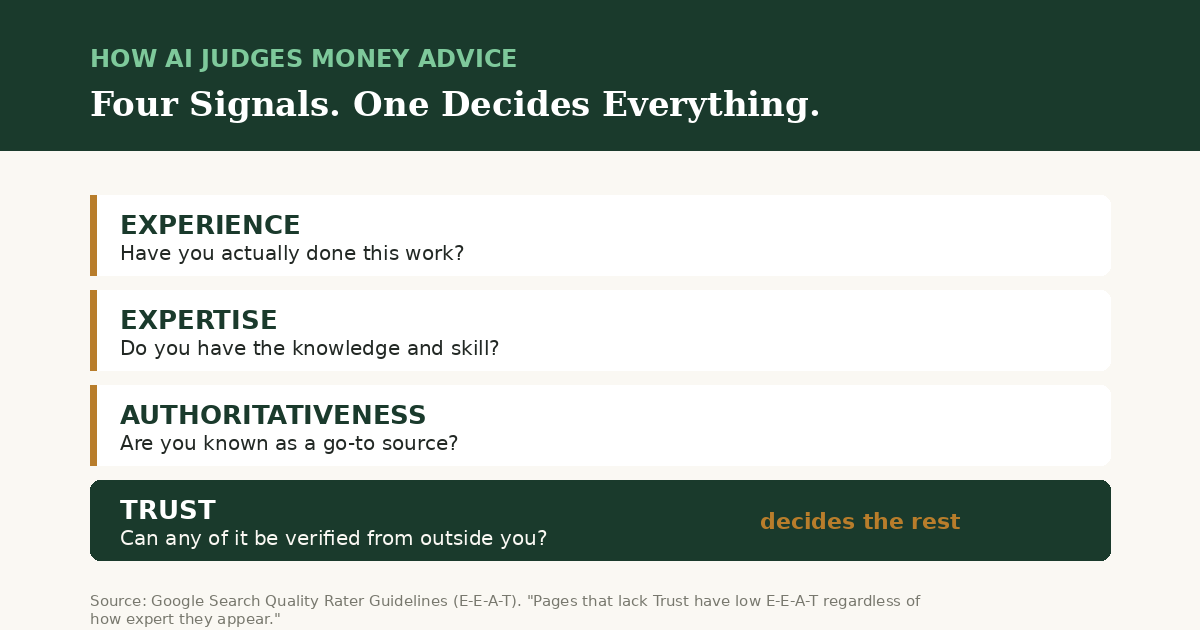
But Google is unusually blunt about the fourth. In its own guidelines: Trust is the most important member of the E-E-A-T family. Pages that lack Trust have low E-E-A-T regardless of how Experienced, Expert, or Authoritative they may otherwise seem. They illustrate it with a deliberately extreme example: a financial scammer might be genuinely experienced, genuinely expert, even genuinely known, and none of it matters, because the content can't be trusted. Expertise without verifiable trust scores as nothing.
Sit with what that means for a working loan officer. You can be excellent. You can have twenty years and a thousand families housed. You can write the clearest explanation of a DSCR loan on the internet. And an AI can still decline to put your name forward, not because it judged your expertise and found it lacking, but because it couldn't find anything outside of you that confirmed you are who you say you are. The care is real. The trust signal is missing. The machine only reads the second one.
The byline nobody thinks about
Here is the most concrete version of the problem, and the one most people never check. Open the last helpful thing your business published about rates, or FHA loans, or refinancing. Look at who it says wrote it.
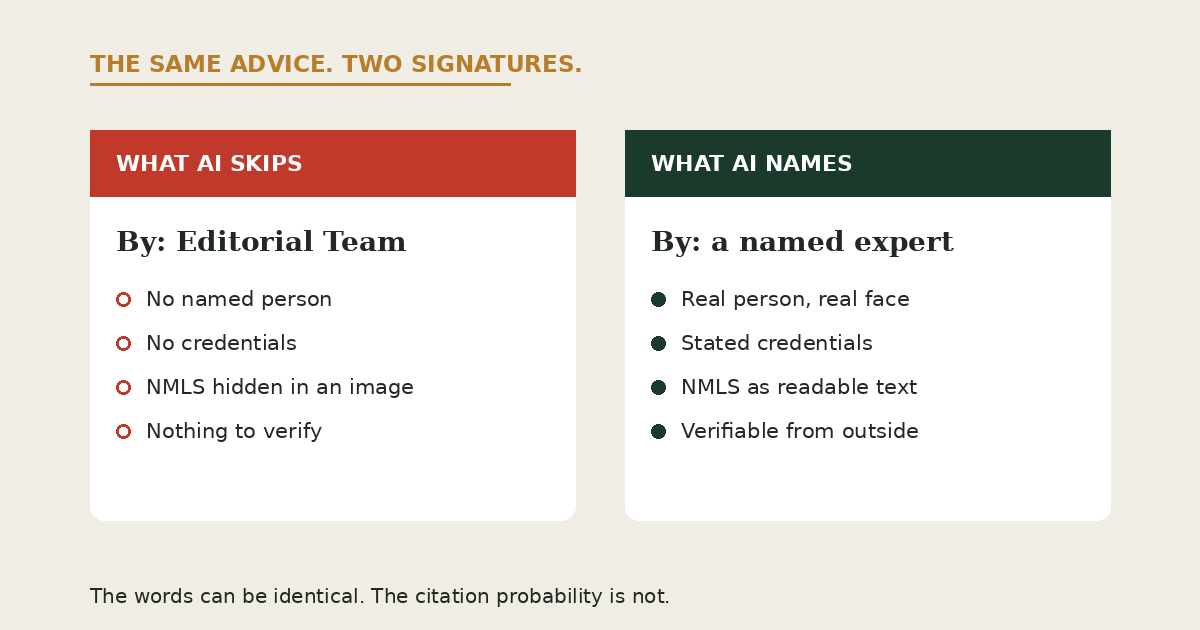
If the byline says "Editorial Team," or "Admin," or nothing at all, you have a structural weakness that no amount of good writing repairs. On a money page, an identifiable, credentialed human is the primary trust signal. An anonymous editorial function names no one, and a system built to be careful with financial advice has nothing to hold onto. The same is true of the single most important number you carry: your NMLS. If it lives only inside a footer image or a PDF, the AI literally cannot read it. It has to be visible text, on the page, as words. That one detail moves you from excluded to eligible, and almost nobody does it.
None of this is exotic. It's the difference between two pages carrying word-for-word identical advice, one signed by a real, verifiable person and one signed by a ghost. To a human reader they look the same. To the system deciding who gets named, they are not remotely the same.
Why the caring ones lose, specifically
This is the quiet injustice in it. The loan officers who put people first are often the ones least likely to have built the machinery that proves it. They're busy taking care of clients, not maintaining an author bio, a credential-rich profile, and a web of external mentions that corroborate their existence. The self-promoters, meanwhile, tend to build exactly that scaffolding, because promotion is the thing they're already doing.
So the filter that was designed to protect borrowers from scammers ends up, by accident, favoring the visible over the trustworthy. Not because the machine prefers the loud. Because trust, to a machine, is not a feeling. It's a set of things it can verify from outside you, and the people most worth trusting are frequently the ones who never built those things.
What actually clears the filter
The good news is that this is mechanical, which means it's fixable, and the fix is honest. You don't trick a YMYL filter. You satisfy it, by becoming genuinely verifiable.
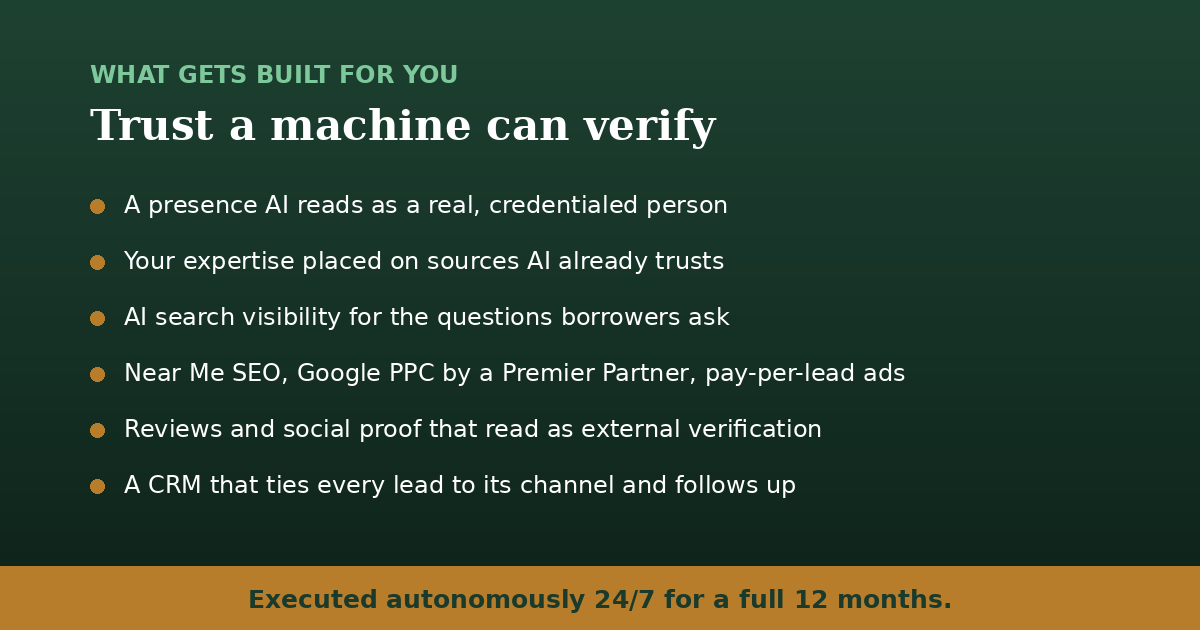
It means a presence an AI reads as a real, credentialed person rather than a faceless brand. Your NMLS and your expertise as readable text where it counts. Your knowledge placed not only on your own site but on external sources the AI already trusts, so that something beyond your own word confirms you, which is the entire point of the fourth signal. Real reviews that function as outside verification. And the ordinary visibility layer underneath it: AI-search presence for the questions borrowers actually ask, local Near Me SEO, Google PPC run by a Premier Google Partner, pay-per-lead Local Service Ads, and a CRM that ties every lead to its source and follows up. Built once, run in the background, so you can keep doing the part only a human can. It's not about sounding more expert. You already are. It's about becoming something a cautious machine is finally allowed to recommend.
You're already trustworthy. The question is whether a machine can prove it.
autonomousgrowth.io starts with one question: how much monthly revenue do you want to add? From there it builds your visibility across 10+ channels and runs it autonomously for a full 12 months. You'll get a Gap Analysis that shows exactly where your digital presence stands today across those channels, and a 12-month plan that shows precisely how your target revenue increase gets achieved, channel by channel, month by month.
Sources: Google Search Quality Rater Guidelines (definition of YMYL; E-E-A-T; "Trust is the most important member of the E-E-A-T family"; treatment of financial content); Google Search Central on E-E-A-T. E-E-A-T is a set of concepts human raters use to evaluate quality, not a score that exists in any system; any tool claiming to output an "E-E-A-T score" has invented it. This article is general information about content and search visibility, not legal, compliance, SEO, or financial advice.