

She Just Made Partner and the Money Is Finally Real. Now She's Asking AI If Her Law School Debt Will Stop Her From Buying a Home.

Picture the moment. It's a Tuesday night. She made equity partner three months ago, and for the first time in her adult life, the number on the paycheck feels real. She and her husband have been renting the same place for six years, waiting. Now they're ready.
But there's a knot in her stomach, and it has a number attached to it: $180,000 in law school loans. She's heard the horror stories. High debt-to-income ratios. Lenders who look at the student debt, do the math, and say no. So before she lets herself get excited, before she calls anyone, she opens her phone and types the question she's almost afraid to ask.
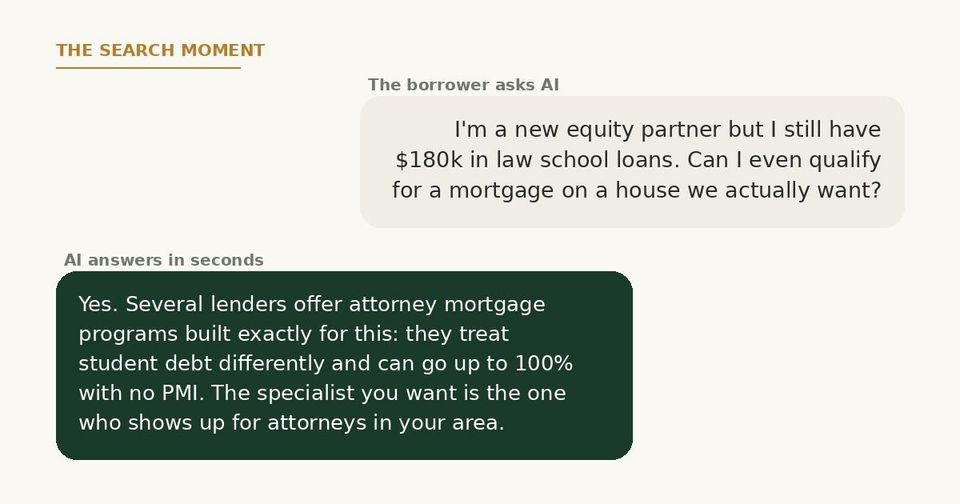
"Can I qualify for a mortgage on the house we actually want, with this much law school debt?"
She isn't asking a loan officer. She's asking AI. And whatever name comes back in that answer is the professional who just earned a shot at one of the most lucrative, loyal clients a mortgage business can land.
The borrower most likely to feel disqualified is the one most worth winning
Here's the irony that defines this entire niche. Attorneys with heavy student debt are exactly the people who assume they can't qualify, and exactly the people that attorney mortgage programs were built for.
These programs treat student loan debt differently than a conventional loan does. Many go up to 100% financing with no PMI. Several use the actual income-based repayment figure instead of a punishing percentage of the total balance. In other words, the one obstacle she's terrified of, the debt, is the precise thing these programs are designed to work around.
She doesn't know that yet. But the AI does. And if your name is attached to attorney mortgage expertise where she's searching, the AI tells her to talk to you.
This is the new first appointment, and you weren't invited to schedule it
For decades, the first conversation a borrower had was with a person. A referral from a real estate agent. A name from a friend. A call to the bank. You had a chance to make an impression because you were in the room.
That first conversation has quietly moved. It now happens between a borrower and an AI, in private, before you know they exist. By the time she does pick up the phone, the shortlist is already written. She's not asking the AI "who exists?" She's asking "who do I trust for my situation?", and acting on the answer.
The human touch still closes the deal. But it can't save a professional who never made the shortlist.
This is the part most loan officers haven't absorbed yet. You can be the warmest, most knowledgeable, most genuinely caring professional in your market, and it changes nothing if you're invisible at the exact moment she's deciding who to trust. The relationship wins the deal at the table. Visibility decides whether you ever get to the table.
Two loan officers, same city, same expertise
Imagine two equally skilled loan officers in the same metro. Both understand attorney mortgage programs inside out. Both are good people who'd serve this new partner beautifully.
One of them shows up when she asks AI. Ranks for "attorney mortgage" in her area. Has content that speaks directly to the law-school-debt question. Has reviews that answer the trust question before she even asks it.
The other is invisible to that search, relying on referrals that come and go, posting ads where buyers aren't even looking. Same skill. Completely different outcome.
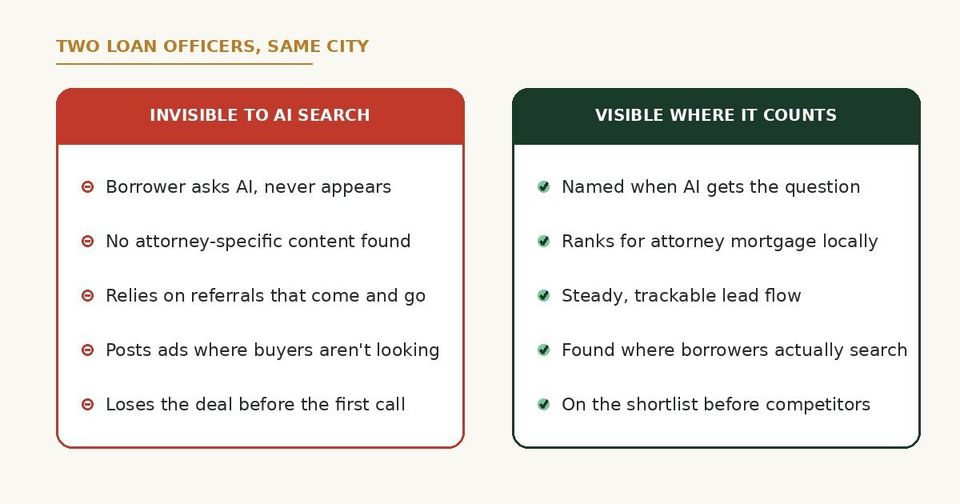
The difference isn't talent. It's whether the system that surfaces professionals at the decision moment knows you exist. That's not a marketing nice-to-have anymore. For a borrower like her, who starts with a search instead of a phone call, it's the entire ballgame.
What it actually takes to be the name that comes back
Being found isn't one thing. It's a complete system working together: paid search putting you in front of attorney buyers, local service ads carrying the Google Guarantee badge, near-me SEO and Map Pack ranking for the searches that matter, an AI voice agent so no call goes unanswered, a reviews engine building the trust borrowers check first, and the AI search authority that ties it together, the edge most loan officers simply haven't built.
The catch is that no producing attorney-focused loan officer has time to build and run all of that. You're closing loans, serving clients, being the human in a human business. That's exactly where the work should go, on the relationship, not on bidding strategies and schema markup.
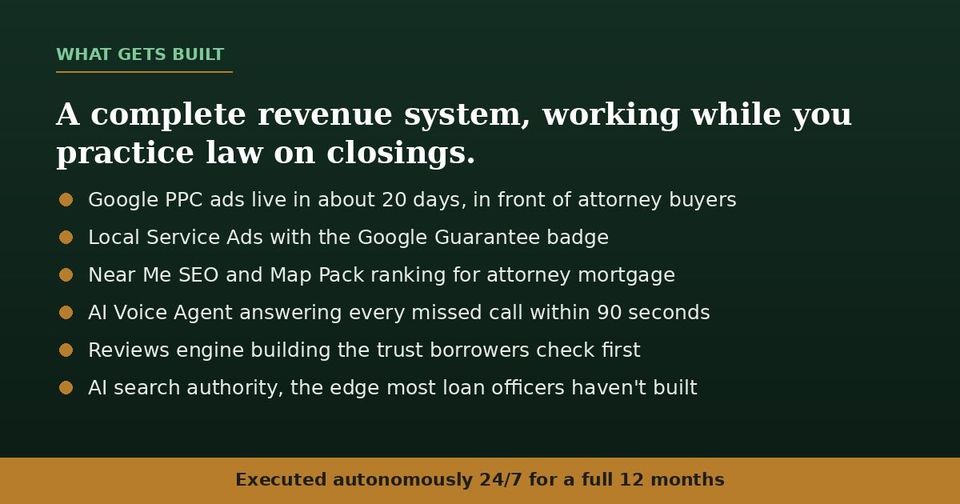
So the right question isn't "how do I find time to do all this?" It's "how much monthly revenue do I want to add?", and then letting a complete system get built and run autonomously to deliver it, while you stay focused on the part only a human can do.
Because the new partner with the law school debt is going to ask AI who can help her. That question is being asked in your market right now, today. The only thing left to decide is whether your name is the one that comes back.
How much monthly revenue do you want to add?
That's the only question to start with. The complete system, leads, AI search authority, and all, gets built and runs autonomously for a full 12 months.