

Two Lenders Told Her the Bankruptcy Made It Impossible. So She Asked AI Who Says Yes.
She had rehearsed the shame so many times it had gone quiet. Two years earlier, a job loss and a medical bill she couldn't outrun had ended in Chapter 7. She'd done the hard part since: rebuilt her credit, paid every bill on time, kept her head down. But somewhere in her, the verdict had already been handed down. People like me don't get to buy a house.
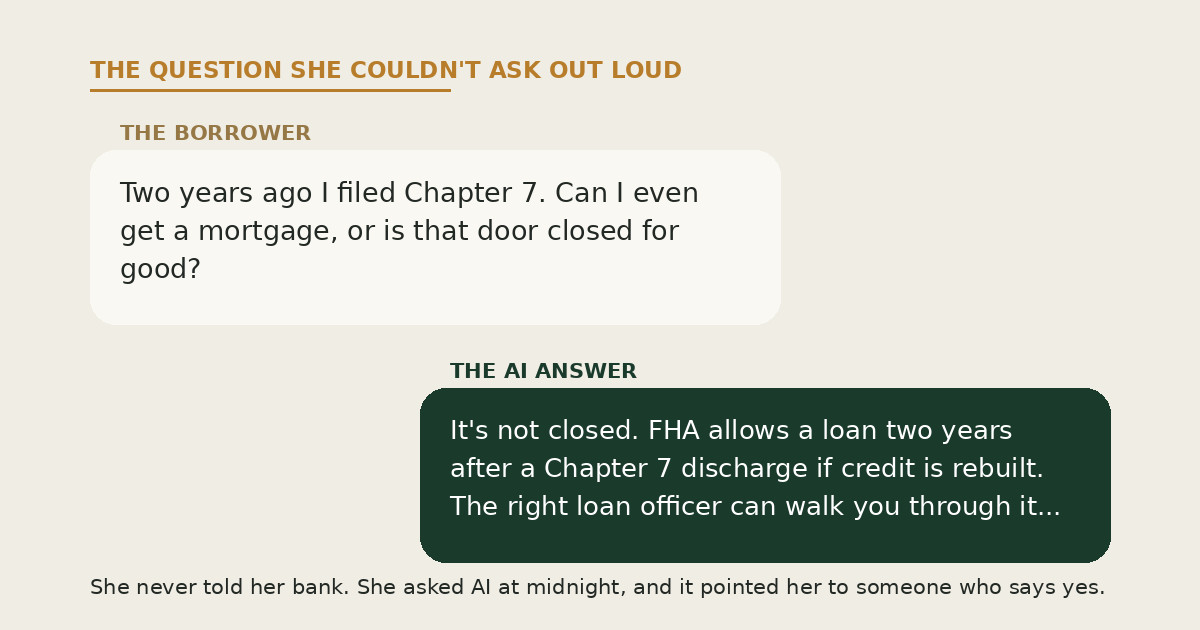
She'd worked up the courage to ask two lenders anyway. Both said no, or said it in the soft, final way that sounds like no. So she stopped asking people. Late one night, alone, she typed the question she couldn't say out loud to anyone who knew her: "Two years ago I filed Chapter 7. Can I even get a mortgage, or is that door closed for good?"
The answer surprised her. Not closed. Waiting period, not life sentence. And whoever the AI pointed her toward, the loan officer who actually understood these files, got the client the two banks had already turned away.
The rules are not what the shame tells you they are
Here is what almost no one going through this knows, because the feeling drowns out the facts. Bankruptcy is one of the most misunderstood situations in all of lending, and the misunderstanding costs people years they didn't need to lose.
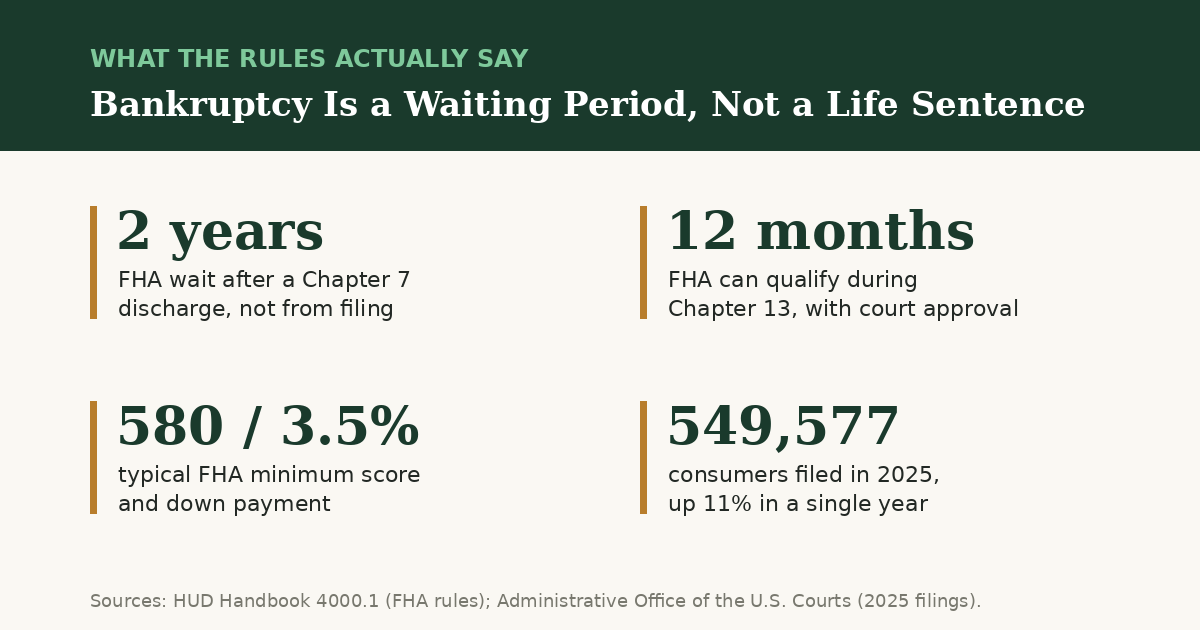
Under FHA guidelines, a borrower can qualify for a mortgage two years after a Chapter 7 discharge, counted from the discharge date, not the day they filed. For Chapter 13, it's even more forgiving: a borrower can often qualify while still in the repayment plan, after just twelve months of on-time payments and written approval from the court. In documented hardship cases, that two-year Chapter 7 window can shrink to twelve months. FHA minimums sit around a 580 credit score and 3.5% down, built precisely for people rebuilding.
And this is not a rare corner of the market. In 2025 alone, roughly 549,000 American consumers filed for bankruptcy, up more than 11% in a single year. Every one of them is a person who will, eventually, want a home again, and most of them have no idea the door reopens as soon as it does.
The one thing the shame guarantees: they won't ask a person
Think about who this borrower is. She has been told no, twice. She is carrying quiet embarrassment about the worst financial chapter of her life. The last thing on earth she wants to do is walk into a bank branch and explain her Chapter 7 to a stranger at a desk, or call a loan officer her neighbor recommended and hear the pause on the other end.
So she does what people do with questions that feel too private to say aloud. She asks AI, at midnight, where no one can see her face. That is not an edge case. For this borrower, it is the only first step she's willing to take. The entire decision about who she trusts begins in a search bar, long before a human is ever involved.
Two loan officers. Both could help her. One is findable.
Picture two loan officers who both genuinely know how to structure a post-bankruptcy file. Both would treat her with dignity. Both would get her to the closing table. The only difference is that one of them shows up when she quietly asks AI whether it's even possible, and the other does not.
The visible one gets to be the person who says the words she'd almost given up on hearing: yes, and here's how. The invisible one never learns she existed. Same expertise. Same compassion. Completely different outcome, decided entirely by who the machine surfaced at midnight.
For a loan officer, this is one of the most meaningful niches there is. These aren't rate-shoppers. They're people who were told no and are bracing to be told no again. Being the name that says yes doesn't just win a loan. It changes how someone feels about their own future. That kind of trust builds a referral engine that lasts for years, because no one forgets the person who reopened the door.
Being the one who says yes, where they're actually asking
Becoming that name isn't luck, and it isn't one clever post. AI doesn't invent who to recommend; it surfaces the professionals it finds consistently present, reviewed, and clearly expert across the web. Building that presence is a system, and it's not something most people can stand up on their own.
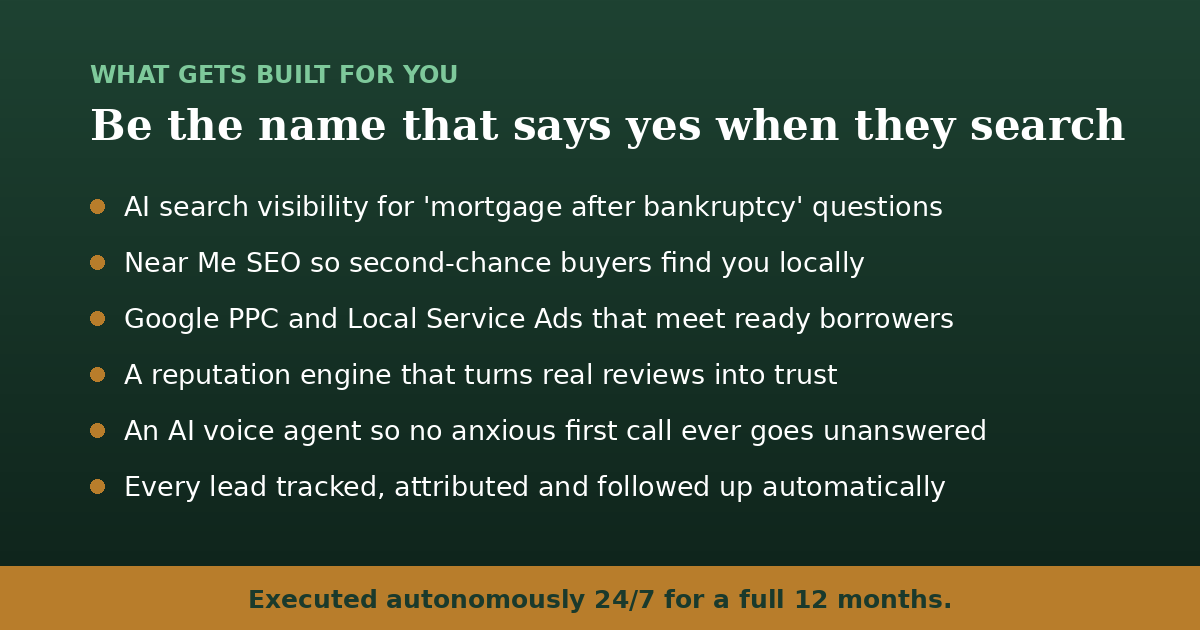
It means AI-search visibility for the exact questions these borrowers ask, local Near Me SEO so second-chance buyers find you, paid search and Local Service Ads that meet ready borrowers, a reputation engine that turns real reviews into trust an AI can read, and an AI voice agent so that no anxious first call, the hardest one they'll make, ever goes unanswered. Every lead tracked and followed up. Not a one-time campaign, but running quietly in the background, executed autonomously, for a full twelve months, so you can do the part only a human can: look someone in the eye and tell them the door is still open.
The people who were told no are already searching. Are you the yes they find?
autonomousgrowth.io starts with one question: how much monthly revenue do you want to add? From there it builds your visibility across 10+ channels and runs it autonomously for a full 12 months. You'll get a Gap Analysis that shows exactly where your digital presence stands today across those channels, and a 12-month plan that shows precisely how your target revenue increase gets achieved, channel by channel, month by month.
Sources: HUD Handbook 4000.1 (FHA bankruptcy waiting periods and qualification requirements); Administrative Office of the U.S. Courts (2025 consumer bankruptcy filings). Waiting periods establish eligibility to apply, not a guarantee of approval; qualification also depends on rebuilt credit, income, and lender requirements. This article is general information, not lending advice.