

They Were Priced Out at 6.5%. The Seller's Loan Was Still at 2.75%.
She had done the arithmetic four times, and it came out the same way each time. The house was reachable. The payment was not. Prices in the neighbourhood had settled, inventory was better than it had been in two years, and on paper they were qualified buyers with steady income and money saved. What had moved was the rate. At 6.5%, the monthly number on a house they liked sat roughly eleven hundred dollars above what they had planned for when they started looking. Not a stretch. A wall.
Then a listing came through with a line in the description most buyers skim past: assumable FHA loan, 2.75%.
She read it twice. Then she did what almost everyone does now before calling anyone. She opened her phone and asked: "Can I take over the seller's mortgage and keep their rate?"
The answer was accurate, and it was not enough
What came back was correct. FHA, VA and USDA loans can be assumed by a qualified buyer. Conventional loans, with rare exceptions, cannot. Because those three government-backed programmes account for roughly thirty per cent of outstanding mortgages in the United States, there are millions of loans a buyer could legally step into — many of them written between 2020 and 2022, when rates sat between 2.5% and 3.5%.
It laid out the hard part too. The buyer qualifies with the seller's existing servicer, not a lender of their choosing. There is an assumption fee. The process commonly runs forty-five to a hundred and twenty days, against roughly thirty for a conventional purchase. And there is the gap: the remaining balance and the sale price are rarely the same number, and the difference has to be covered in cash or through a second loan.
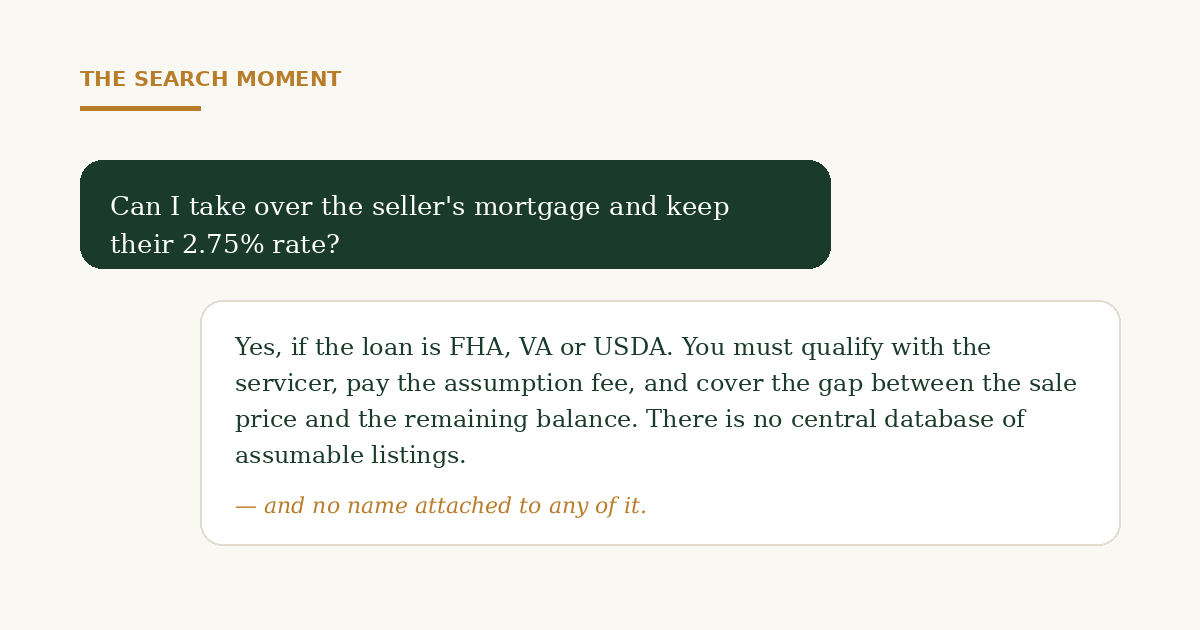
All of it true. None of it a plan. Because the question underneath hers was never really what is an assumable mortgage. It was: who, near me, has actually done one of these and can tell me in ten minutes whether it works for this house?
Why almost nobody handles these
There is a reason that expertise is thin on the ground, and it is worth saying plainly rather than pretending the market simply overlooked something.
An assumption runs through the seller's existing servicer. The servicer underwrites it, the servicer sets the pace, and the loan officer guiding the transaction often earns nothing on the loan itself. It takes three to four times as long as a conventional purchase with almost none of the control — no choice of lender, no ability to escalate, no leverage on timelines. Whatever compensation exists usually sits somewhere else: in structuring the second loan that covers the gap, or in the relationship that follows.
So the incentive points the other way. It is quicker and cleaner to write a new loan at market rate and move on. That is not cynicism; it is arithmetic, and most of the industry has quietly done it.
The seller had the same problem, from the other side
Two streets away, a different house was listed with a VA loan at 2.99%. The owner had bought it in 2021 with his benefit, and he was selling because his wife's job had moved. His agent had heard that a VA loan could be a selling point in a 6.5% market, and had put "assumable" in the listing.
Neither of them knew what that sentence could cost him. When a buyer who is not a veteran assumes a VA loan, the seller's entitlement stays attached to that loan until it is paid off. Not until closing. Until the loan is retired — which, on a thirty-year mortgage taken over by a stranger, may be decades. For that entire period, the portion of his benefit tied up in the old house is unavailable for the next one. He could still buy, but not on the terms he had earned.
There is a way around it. If the buyer is an eligible veteran with entitlement of their own, they can substitute theirs for his, and his is restored. That single distinction — veteran buyer or not — is the difference between a clean exit and a benefit frozen for the better part of a working life.
It is not an obscure rule. Any loan officer who has handled a VA assumption knows it and raises it in the first conversation, because it is the first thing that matters. But it only gets raised if someone in that first conversation knows it — and the seller's first conversation was with his agent, who had read the same summary he had. The second was with his phone.
Two loan officers. Both could have helped. One is findable.
Somewhere within twenty miles of that listing was a loan officer who had closed assumptions before. Who knew which servicers move quickly and which will take the full four months. Who could look at the balance and the price and say within minutes whether the gap could be bridged, and how. Who could have explained to both sides what they were actually signing.
That person existed. Neither party had any way to arrive at them.
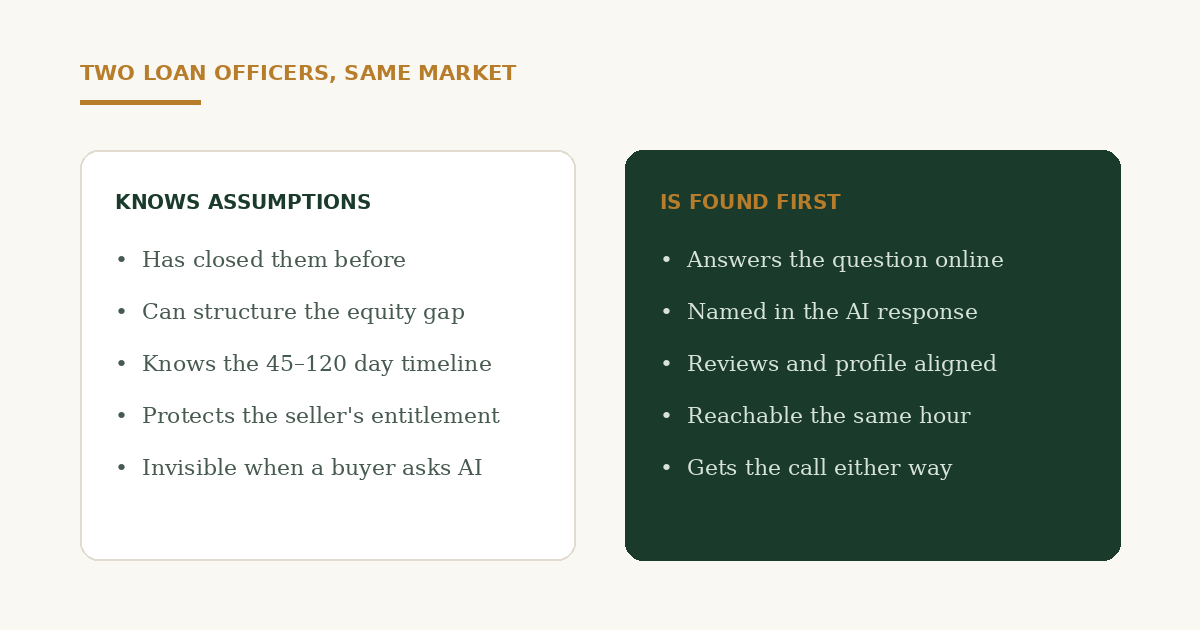
This is the part of the market that has quietly changed. Expertise used to reach people through referral: an agent who knew someone, a colleague who had done one before. That still happens. But it now happens second. The first conversation takes place between a person and a machine, at ten at night, and that machine assembles its answer from what is publicly available and consistently stated — content that addresses the question, a profile that says what someone actually does, reviews that describe real situations, mentions that come from somewhere other than the professional's own website.
At that moment, a loan officer with fifteen years of assumption experience and no public footprint is indistinguishable from one with none. Scarcity only pays if the people looking for you can find you.
What happened to the deal
She called the number on the listing. The agent had written "assumable" into the description without having handled one, which happens more often than either side would like. Two weeks passed. The servicer's assumption department was reachable only by phone, and only in a window that did not overlap with her working day.
By the time someone was found who could actually run the numbers, the house had gone to a buyer paying market rate with a conventional loan and a thirty-day close.
Nobody in that story did anything wrong. The rate existed. The buyer qualified. The programme worked exactly as designed. What failed was the introduction — the ten metres between people with a question and the person with the answer.
Being the one who can, where they're actually asking
Assumptions matter now because of a gap that will not last forever. While rates stay elevated, every 2020-era loan is worth more to the next buyer than to the market. As rates come down, that gap narrows. The professionals who build a reputation for handling these now will still have it when the market turns; the ones who wait will be building it into a smaller opportunity.
And a capability the rest of the industry avoids is the most defensible position there is — but only for as long as the people who need it can reach you. Being the only one who does the work is worth nothing if you are also the one nobody can find.
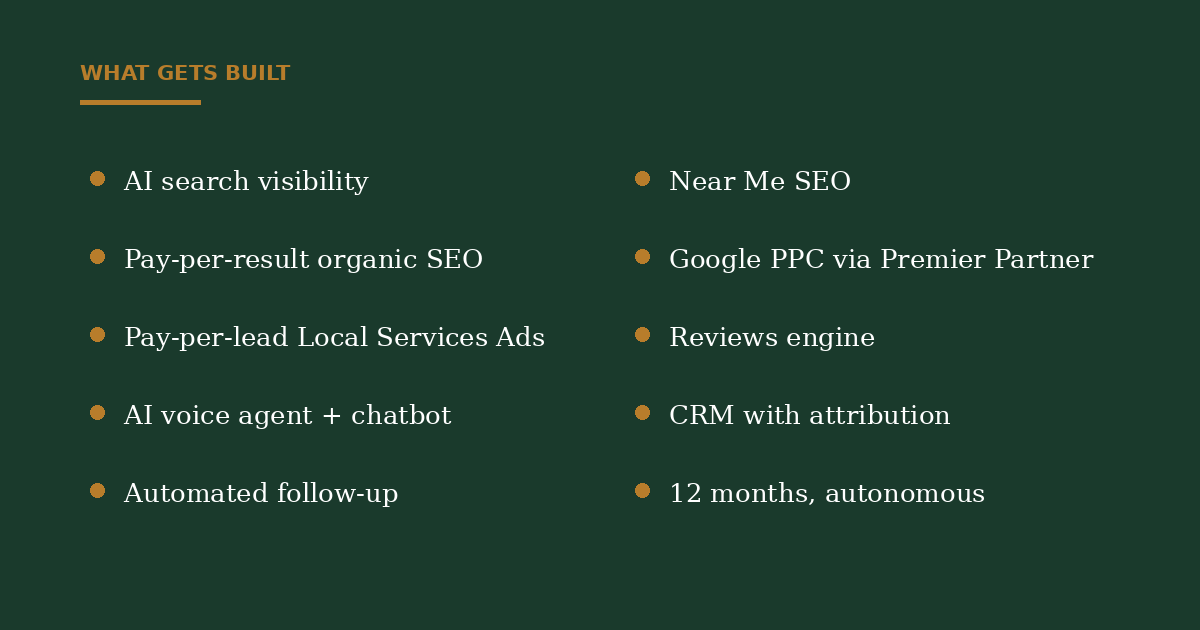
Becoming that name isn't luck, and it isn't one clever post. AI doesn't invent who to recommend; it surfaces the professionals it finds consistently present, reviewed and clearly expert across the web. It means AI-search visibility for the exact questions these buyers and sellers ask, local Near Me SEO, paid search and Local Service Ads that meet ready borrowers, a reputation engine that turns real reviews into trust an AI can read, and an AI voice agent so the first anxious call never goes unanswered. Every lead tracked and followed up. Not a one-time campaign, but running quietly in the background, executed autonomously, for a full twelve months — so you can do the part only a human can: pick up the phone and tell someone whether the thing they found is actually possible.
The buyers and sellers who need this are already searching. Are you the name they find?
autonomousgrowth.io starts with one question: how much monthly revenue do you want to add? From there it builds your visibility across 10+ channels and runs it autonomously for a full 12 months. You'll get a Gap Analysis that shows exactly where your digital presence stands today across those channels, and a 12-month plan that shows precisely how your target revenue increase gets achieved, channel by channel, month by month.
Sources: U.S. Department of Veterans Affairs (VA loan assumption requirements, funding fee, entitlement and release of liability); HUD Handbook 4000.1 (FHA assumption requirements). Loan programme details vary by servicer, loan type and borrower, and eligibility to apply is not a guarantee of approval. This article is general information, not lending or legal advice. Anyone considering an assumption — as buyer or seller — should confirm the specifics with a licensed mortgage professional and the loan's current servicer before committing.