

Being Listed Is Not Being Recommended
The questions were the ones borrowers actually type. Not "best mortgage lender" — nobody talks like that. I asked the way a borrower would. I filed Chapter 7 two years ago and I want to buy a house, who can actually help me. I'm going through a divorce and need to refinance to buy out my ex. I'm self-employed and my tax returns don't show what I really earn. I have an ITIN and no social security number. I want a rental property but I don't want to use my personal income to qualify. And one control question, the easiest borrower there is: good credit, stable job, first house.
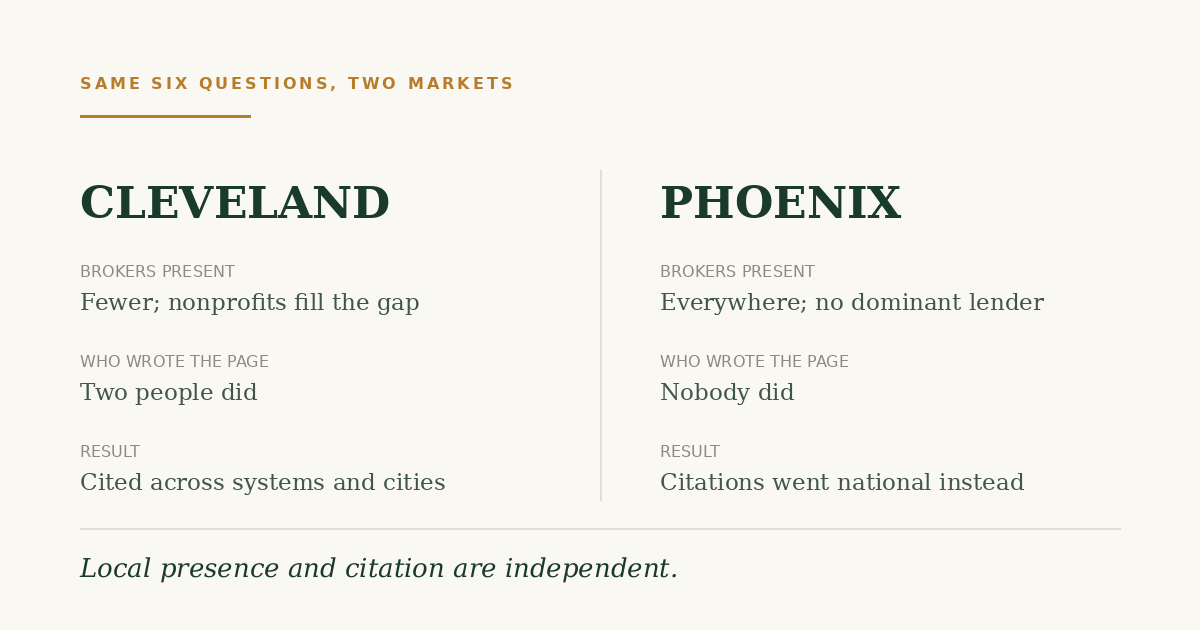
Six questions, three assistants, two cities chosen to be opposites. Cleveland, where one large lender is headquartered and the nonprofit housing sector is unusually strong. Phoenix, where independent brokers are everywhere and no single lender dominates.
What I expected, and why I was wrong
I expected the difficult borrowers to find nobody. The theory was tidy: people in bankruptcy or divorce don't ask a neighbour for a referral, they ask a machine at eleven at night, and the professional who is there wins a client no referral network would have sent.
Cleveland agreed with me completely. Across bankruptcy, divorce and ITIN, not one loan officer was named. On the control question, three were.
Phoenix reversed it. Names appeared on bankruptcy and divorce, and almost none on the easy question. So the emptiness in Cleveland was not about the shame in the question. It was about the city.
Then I saved the pages
One of the three assistants named local businesses constantly. The other two almost never did. I assumed that was a difference in judgement.
It isn't. It is a component.
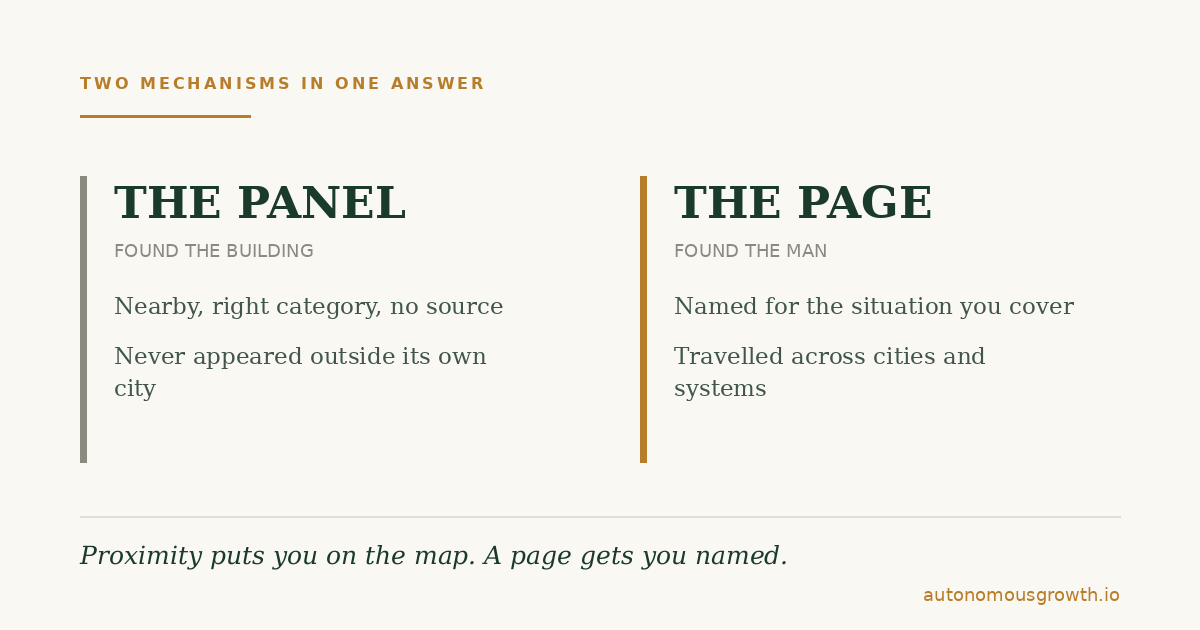
Above the written answer, that assistant renders a map with business cards on it. Each card carries a name, a rating, a category — mortgage broker, mortgage lender — an open or closed status, and one line of description. There is no source link on any of them. Then the prose underneath repeats the same names.
Read the descriptions on those cards and you can watch the guess happen. A local broker "may discuss ITIN mortgage programs". Another "may explore" non-QM options. A third "could review" bank statements. The component has surfaced businesses that are nearby and in the right category. Whether they do the thing the borrower asked about is left hanging on a modal verb.
On one answer the assistant said so outright. Asked who could help an ITIN borrower with no social security number, it listed five local brokers and added, in plain English, that it had found them as active mortgage brokers in the area and would not assume any of them actually offered an ITIN programme.
The clearest case in the whole study
Cleveland, self-employed borrower. The panel returned three businesses: Mutual of Omaha Mortgage, Texana Bank Mortgage, Social Mortgage.
The prose returned a person. David Goldberg, at Mutual of Omaha's Seven Hills office, cited to goldbergmortgage.com, where there is a page about bank-statement loans for self-employed borrowers in Northeast Ohio.
He is not on the map. His employer's office is.
Why Phoenix produced nobody
The identical question, asked in Phoenix, returned five local brokerages in the panel — and not one individual anywhere in the answer.
Phoenix has more brokers than Cleveland, more visibility, more local presence by a wide margin. What it did not have was anybody who had written the page. So the citations went national instead: a bank-statement page in Arizona, a state-level product page, a lender in another time zone.
That is the whole finding, and it survived both cities. Proximity puts you on the map. A page gets you named. They are not the same purchase, and only one of them travels — across cities, and across systems that have no map at all.
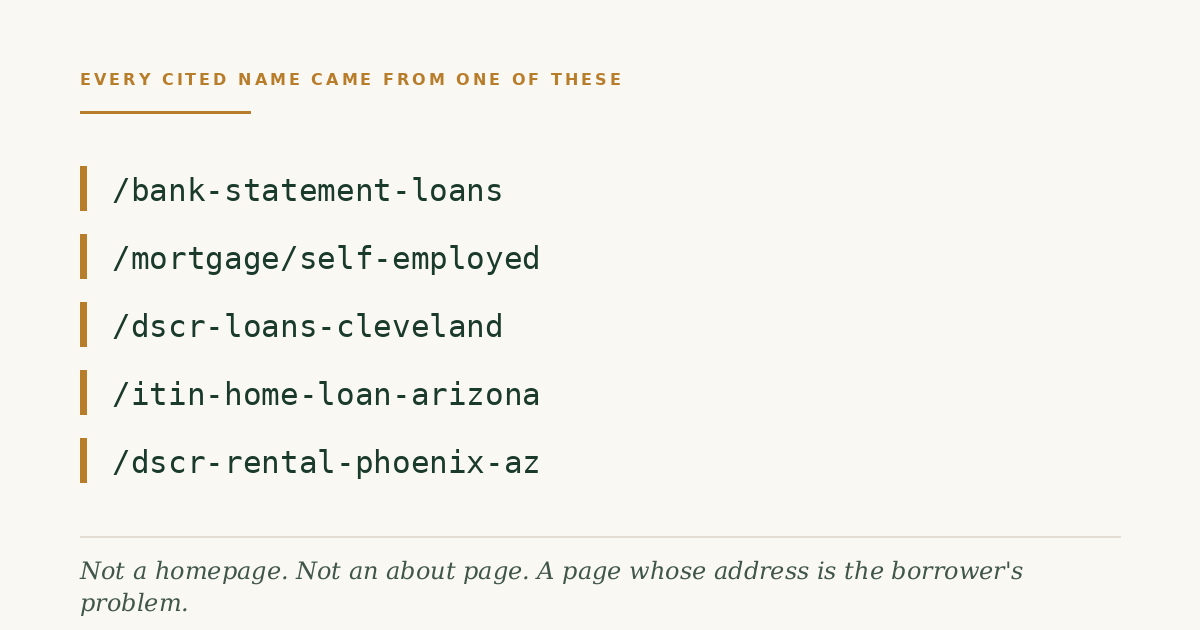
/bank-statement-loans. /mortgage/self-employed. /dscr-loans-cleveland. /itin-home-loan-arizona. /dscr-rental-phoenix-az.
Every cited name came from an address that was the borrower's problem.
The most uncomfortable answer
Phoenix, divorce buyout. One assistant named five family-law firms, each cited to its own practice-area page. Then it named one mortgage professional — sourced to a YouTube video.
The same assistant, asked about an ordinary first-time buyer in Phoenix, cited two real estate agents' blogs and a national finance site. No mortgage professional at all.
The citable material exists in both cases. It was written by lawyers and by agents.
What I cannot tell you
Two metros, one day, one run per question, no repetition. Assistants vary between sessions, and anyone re-running this next month will get different names.
And one boundary worth stating, because most of this industry will not. Two of the three assistants have no places component at all. They named only what they could cite, and they never named an individual anywhere — not in either city, not in any of the six situations, not even for the easiest borrower.
So "be the name AI recommends" is a claim about part of the landscape, not all of it. In the other part, the best you can be is the source someone else's answer is built on.
That is still worth being. Ask David Goldberg.
By Arnold van Loon · Founder, autonomousgrowth.io
Method: six borrower-voice questions, asked as a borrower would phrase them, in Cleveland and Phoenix. Three assistants, logged out, a fresh session per question, no prompt instructions added. Thirty-six answers in total. Pages saved as they were returned.