

How Loan Officers Get Recommended by AI in 2026 — 7 Approaches, Ranked
The first conversation a borrower has about their mortgage increasingly doesn't involve a loan officer at all. It happens with an AI — who handles VA loans in my city, who works with self-employed buyers, who can I trust with this. By the time someone picks up the phone, a shortlist has already formed, and the names on it weren't chosen because they're the best. They were chosen because they were the most findable.
That's a different skill from originating loans, and almost nobody was taught it. What follows are the seven approaches that determine whether an AI names you, ordered by how much they actually move the needle — drawn from independent studies of what these systems cite, and from direct measurement of what they return today.
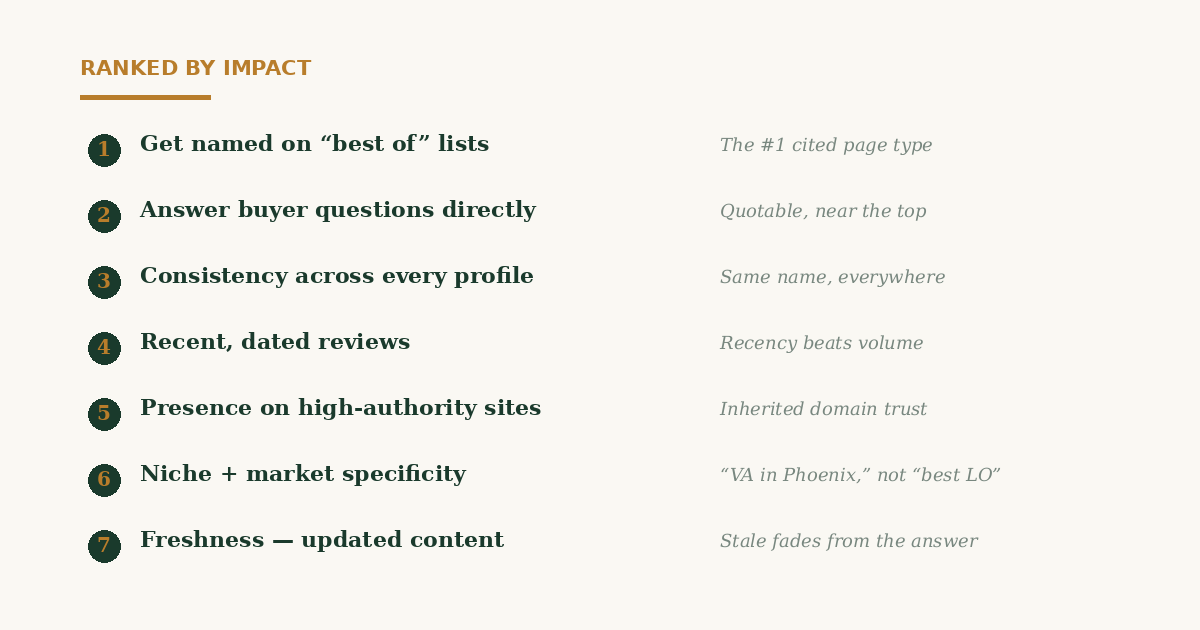
Get named on "best of" lists
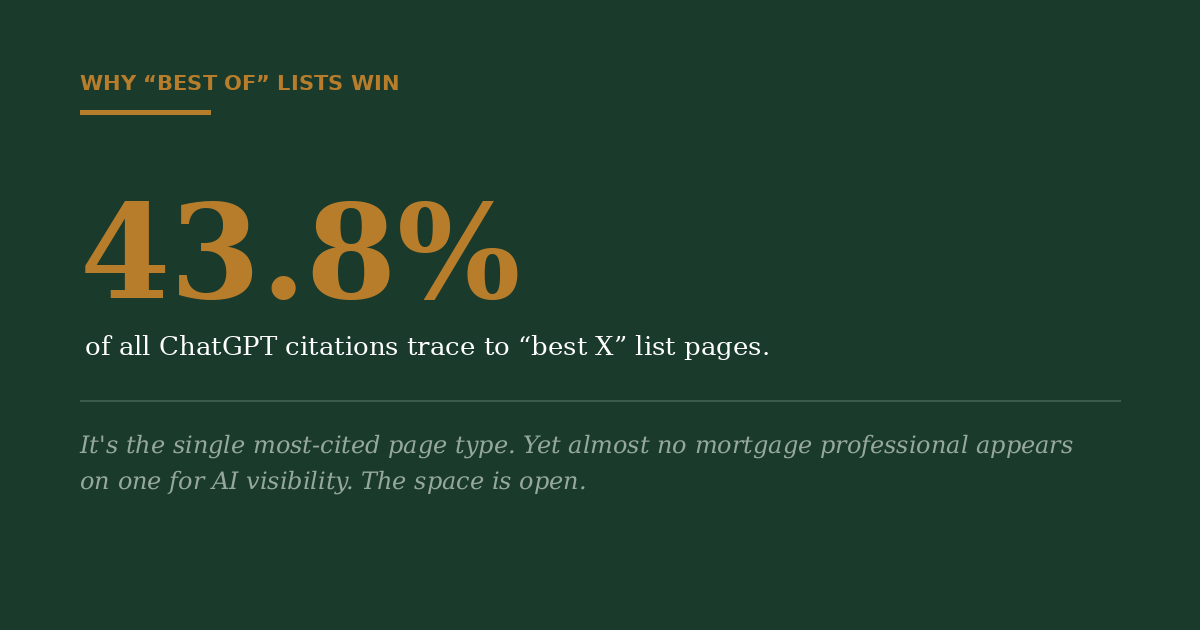
This is the single highest-leverage thing on the list, and it surprises most people. An analysis by Ahrefs of tens of thousands of ChatGPT source URLs found that a large share of all citations — the biggest slice by page type — trace back to "best X" list articles: "best mortgage brokers in Austin," "top VA loan specialists," and the like. The AI doesn't cite your homepage. It cites the third-party page that names you. Which means the goal isn't to write about yourself; it's to be included on the pages other people are already citing.
Answer buyer questions directly, near the top
The overwhelming majority of cited content answers the question plainly, in the first hundred words, in language a machine can lift and quote. Not buried under introductions, not wrapped in brand voice or sales language. The research is blunt about this: promotional writing and technical tricks are overrated. What helps a person researching a decision helps the AI researching it too. Write the answer to "can I get an FHA loan with a 580 score" as if someone will quote one clean sentence of it — because that's exactly what happens.
Keep every profile consistent
AI systems assemble a picture of you from many places at once, and they trust what multiple independent sources confirm. If your name, market, license number, and specialty read the same across your site, your Google profile, LinkedIn, and directory listings, you register as one clear, verifiable entity. If they conflict, you blur — and a blurry entity is easy to skip.
Collect recent, dated reviews
Recency beats volume. A steady stream of detailed, recent reviews signals an active, trusted professional more strongly than a large pile of old ones. The specifics matter too — reviews that mention the loan type, the timeline, and the local market give the system concrete language to attach to your name.
Earn presence on high-authority sites
This is where individual professionals hit a wall. Studies of what AI cites show a steep relationship between a source's authority and how often it's cited — heavily-referenced domains are cited several times more often than weakly-referenced ones, and below a certain traffic threshold, sites cluster together in the same low range no matter how good they are. An individual loan officer's own website almost never clears that bar alone. The workaround is to be present on sites that already have the authority — through genuine mentions, contributed articles, and coverage — rather than trying to build it from scratch on your own domain.
Get specific: niche plus market
"Best loan officer" is a claim no AI can verify and everyone makes. "VA construction specialist in Sarasota" is a claim the system can match to a specific borrower's specific question. The narrower and truer your positioning, the more precisely you get matched — and the emptier the competition. The sharpest niches, VA, construction, self-employed, are exactly the ones where the AI answer is nearly blank today.
Keep it fresh
Most top-cited pages were created or meaningfully updated recently. Content that sat untouched for three years, however good it once was, quietly fades out of the answer. Updating your pages with current figures and examples on a regular schedule is a low-effort way to stay in the set.
The pattern underneath all seven
Read the list back and one thing connects every item: none of them is about being good at your job. They're about being legible to a machine that decides, before any human conversation, whose name is worth surfacing. Measured directly — the same questions asked across ChatGPT, Gemini and Perplexity — the mortgage category today returns a scattered, inconsistent set of names, with no single professional or provider owning the answer. That's not a crowded field. It's an open one, and it stays open only until enough people learn these seven approaches.
The one gap that remains
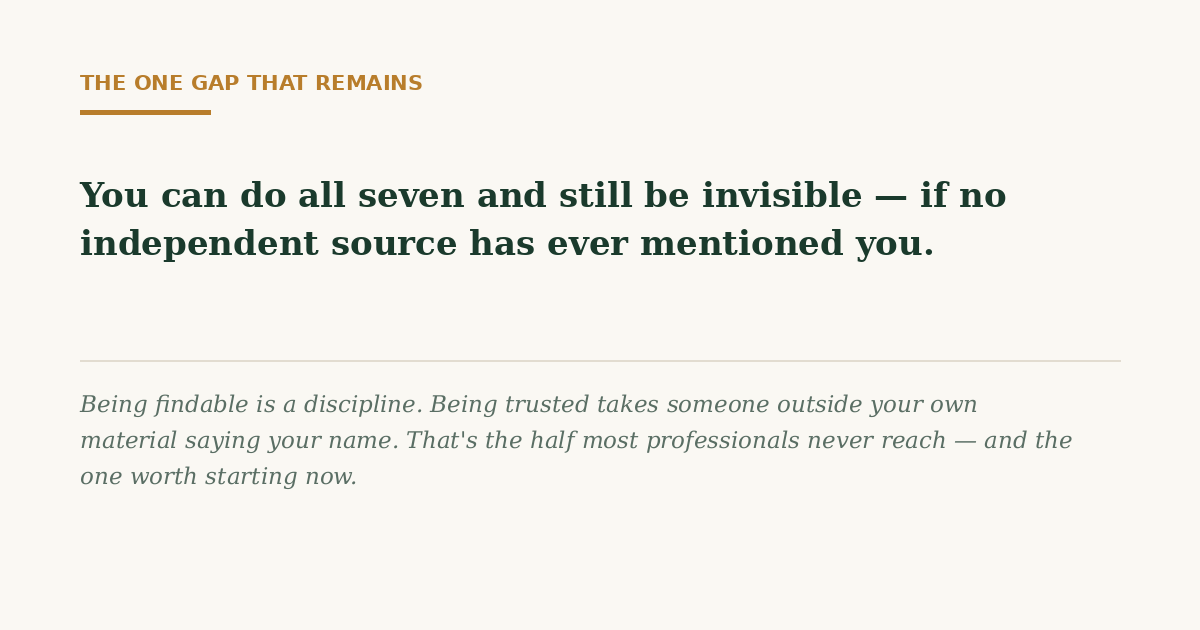
There's an honest limit worth stating plainly, because most guides won't. You can do all seven of these well and still fall short on the thing that turns visibility into trust: independent, third-party coverage. If every source describing you is a source you published yourself, an AI can find you but has nothing outside your own words to corroborate. No technical step closes that gap. What closes it is someone else — a genuine list, a real mention, an actual client speaking in public — saying your name. That's the harder, slower half of the work, and it's what separates being findable from being recommended.
The professionals who start now — while the category is still open and no single name owns it — are the ones the machine will be naming a year from now. The rest will spend that year wondering why borrowers who never called them chose someone else. The difference won't be talent. It'll be that one of them was findable, and the other assumed being good was enough.
This guide was compiled by autonomousgrowth.io, which measures and builds AI visibility for mortgage professionals in the US.
Sources: Ahrefs analysis of ChatGPT source URLs; SE Ranking analysis of 129,000 domains and 216,524 pages. Direct measurements referenced were taken in July 2026 across ChatGPT, Gemini and Perplexity, logged out, with a fresh session per question and sources requested in each prompt. AI-generated answers vary by session, location and model version; readers should run their own measurements rather than rely on figures reported here.