

America Was Built on Freedom. Your Mortgage Should Be Too.
We're taught to shop for a mortgage the way we shop for anything else: find the lowest number and win. It's what gets advertised, what comparison sites rank, what borrowers are told to chase. And on a spreadsheet, the lowest rate looks like the whole story.
But a mortgage doesn't live on a spreadsheet. It lives inside someone's life. And a life, as anyone who has lived one knows, does not hold still. On the week we celebrate the freedom to build the life you choose, it's worth remembering that a home loan is supposed to serve that freedom, not quietly take it away.
People almost never move for the reasons a rate can measure
According to the U.S. Census Bureau, only about a fifth of moves are driven by employment. Roughly four in ten are driven by family or deeply personal reasons that no interest rate can account for. When you sit with people at the moment they decide to move, the real reasons are rarely financial at all.
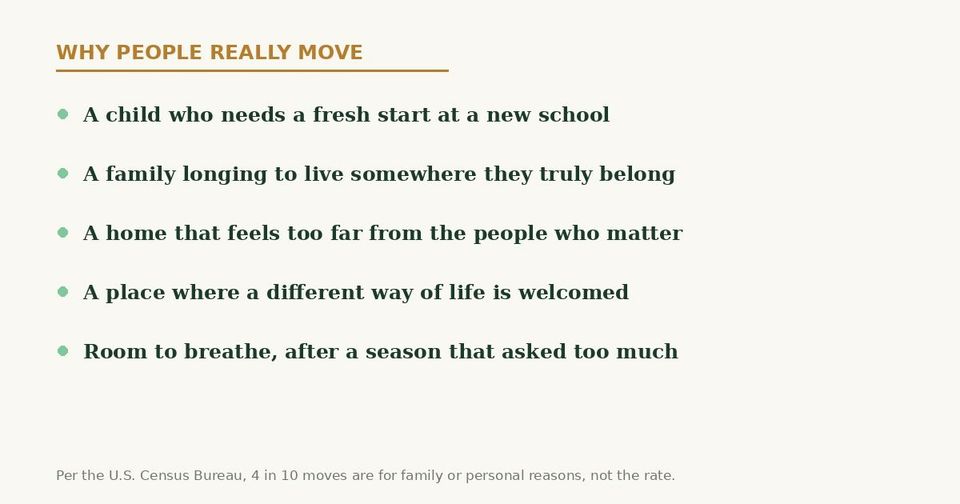
A parent quietly deciding it's time to give a child a fresh start somewhere kinder. A family longing to live somewhere they feel they truly belong. A home that has slowly come to feel too far from the people who matter, or a life that needs a little more room to breathe after a season that asked too much. A couple looking for a community where their way of life is simply welcomed, no explanation required.
These are the real reasons people pack up a home. Every one of them is really about freedom, and none of them fit in a rate quote.
Here is the quiet truth that a long career in this business teaches you: the person facing one of those moments doesn't need the cheapest loan. They need one that won't punish them for being human, for having a life that changed. They need terms that flex. The freedom to move again if they must, to refinance without a penalty that feels like a cage, to adapt when the ground shifts under them, as it always eventually does.
The lowest rate can quietly become the highest cost
A mortgage with the lowest rate but rigid terms can look like a win on the day you sign it, and become a cage two years later when life asks you to move. A slightly higher rate that leaves you free, free to adapt, to refinance, to relocate without being penalized, can be the thing that lets a family do what they need to do when it matters most. That is what freedom in a mortgage actually looks like. Not the smallest number. The most room to live.

This is the difference between a loan officer who sells a number and one who serves a person. The first asks, "what rate are you looking for?" The second asks, "what does your life look like, and what might it look like in three years?" One is optimizing a transaction. The other is protecting a family's freedom to change course. Only one of them is worth trusting with the biggest financial decision of your life.
The best people in this business already know this
Here's something I've noticed, spending this year talking with mortgage professionals all over the country. The ones who are genuinely successful, the ones people trust and return to and send their friends, are almost never the ones shouting the lowest rate. They're the ones who lead with the human being first.
And that isn't a soft, feel-good coincidence. It's the reason they win. Because a mortgage is the biggest decision most people will ever make, and on a decision that size, people can feel the difference between someone selling them a product and someone protecting their life. The humanists aren't successful in spite of putting people first. They're successful because of it. On a decision this important, being truly seen is worth more than an eighth of a point, and people know it.
Which is exactly what a machine can't do
This matters more now than it ever has. When someone opens ChatGPT or a search engine's AI and asks, "what's the best mortgage?", the answer comes back the only way it can: as a rate. A number. Because a number is all an algorithm can compare. It has no way to know that the person asking is really trying to get their child out of a hard situation, or find a place where they finally feel at home, or simply keep the freedom to move again someday.
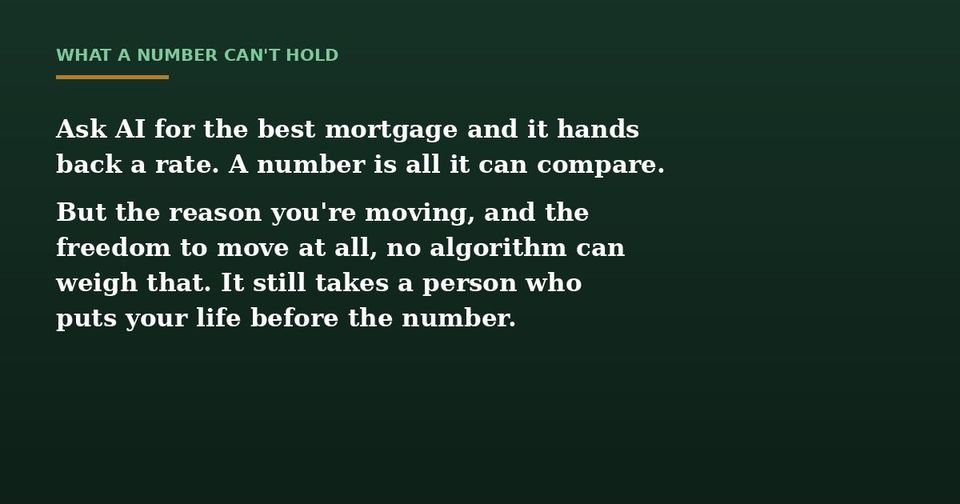
The rate, a machine can find in a second. The human reason behind the move, and the freedom that move represents, it cannot weigh at all. That part still takes a person. Someone who listens before they quote. Someone who understands that the goal was never a lower payment; the goal was a life that stays free to change.
A machine can find you the lowest rate. It cannot ask why you're really moving, and then protect your freedom to do it.
So there's a real risk in this moment. As more borrowers ask AI who to trust and what to choose, the whole conversation gets pulled toward the one thing machines are good at: the number. And the loan officers who understand that a mortgage is about a life, and a freedom, not a rate, are often the very ones who are hardest to find online. Not because they aren't the right people, but because they've been busy taking care of people instead of building their own visibility.
The ones who protect your freedom should be the ones you find
That's the part worth setting right. If you're the kind of loan officer who asks about the life before the loan, who has quietly helped families move for reasons that never showed up on any application, then you are exactly who a searching, worried, hopeful borrower most needs to find. And right now, when they ask AI, they probably won't find you, not because you aren't the right person, but because no one ever told you that you had to show up where that question now gets asked.
Being that name isn't about gaming an algorithm. It's about making sure the people who lead with care are visible to the people who need care, in the exact place they now go looking. Because on the week America celebrates 250 years of freedom, the borrower deciding who to trust deserves to find the person who will protect theirs, not just the one offering an eighth of a point less.
The lowest rate will always have someone advertising it. The deeper question is the one that actually shapes a life, and it's the most American question there is: when your world changes, will your mortgage, and the person who gave it to you, keep you free?
How much monthly revenue do you want to add?
If you lead with the person before the rate, let a complete system make you the name they find when they search, so the borrowers who need care can actually reach the ones who protect it, for a full 12 months.