

She Made More Than Her W-2 Friends and Still Got Rejected. Here's the One Document That Explains Why.
She'd built something real. Years of hard work, a business that cleared more than most of her salaried friends took home, savings in the bank. When she applied for a mortgage, she assumed it would be the easy part. Instead, she got a no. Not because she couldn't afford the home, but because of a single number on a single document. And she's far from alone: roughly ten million Americans are self-employed today, back to pre-pandemic highs, and a large share of them run into the exact same wall.
If you're a loan officer, this is one of the most misunderstood, and most winnable, borrower situations you'll encounter. If you're the borrower, understanding it changes everything. So let's break down exactly what happens, and what the options actually are.
The real reason the denial happens
Here is the heart of it, and it surprises almost everyone. Self-employed borrowers usually don't get denied because they earn too little. They get denied because of which document the lender is required to read.
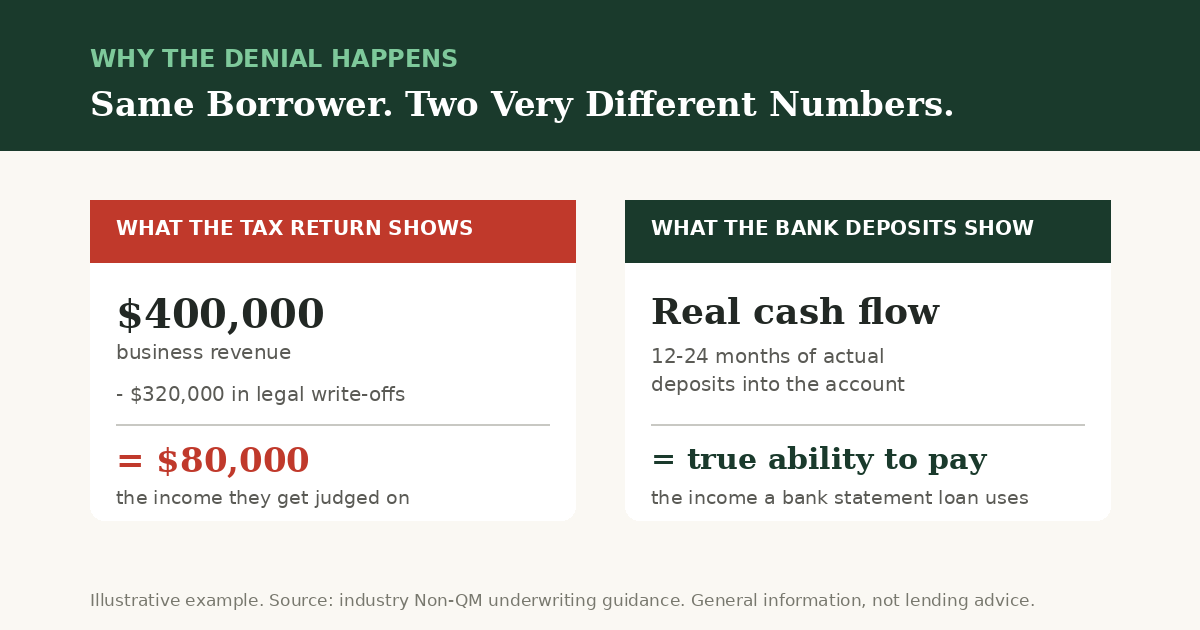
A conventional mortgage qualifies you on the net income shown on your tax returns. But self-employed people, doing exactly what every good accountant tells them to do, write off legitimate business expenses to lower their taxable income. Consider a business owner running $400,000 in revenue who deducts $320,000 in real, legal expenses. On paper, they qualify on $80,000. Their actual ability to pay is far higher, but the tax return doesn't show it. The system effectively punishes people for smart, legal tax strategy. The money is real. It's just sitting in the deposits, not on the 1040.
The paths most borrowers never hear about
This is where it gets hopeful, because the industry has actually built answers for exactly this profile. These fall under what's called Non-QM lending (non-qualified mortgage), and the volume has doubled between 2023 and 2025 as self-employment has climbed. They aren't loopholes. They're legitimate loans that simply read a different document.
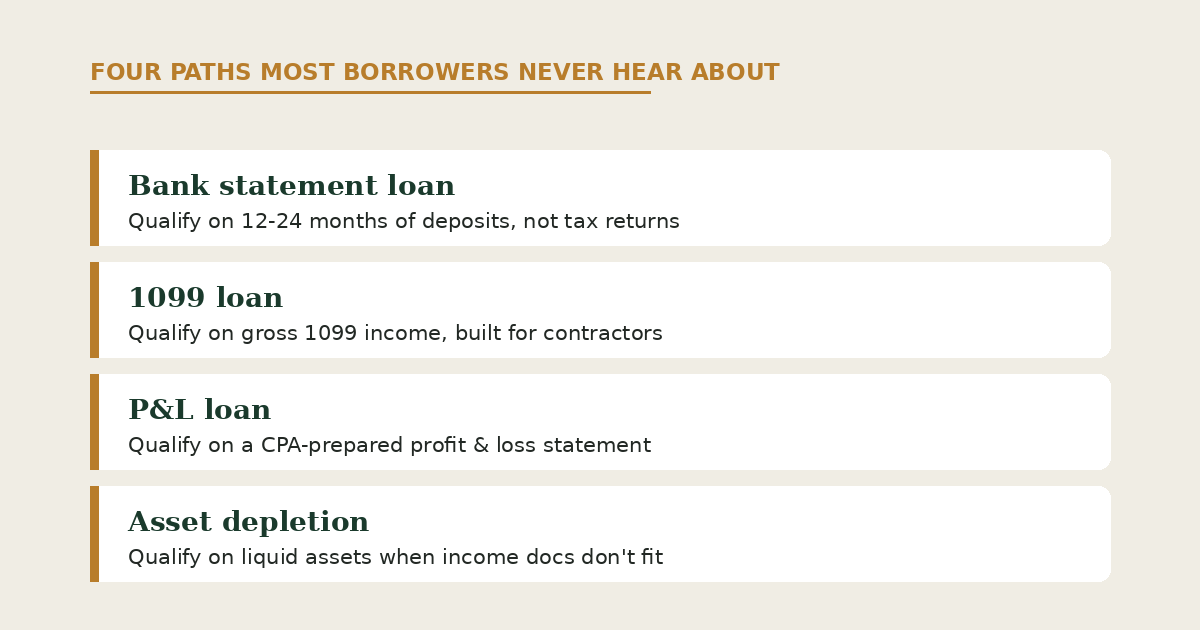
The most common is the bank statement loan, which qualifies you on 12 to 24 months of actual deposits rather than tax returns, measuring the real cash flow moving through your accounts. There's the 1099 loan, which uses gross 1099 income and is built for contractors and commission earners. There's the P&L loan, which qualifies on a CPA-prepared profit and loss statement. And there's asset depletion, which lets borrowers with significant liquid assets qualify on those assets when traditional income documentation doesn't fit. One borrower, denied three times by conventional lenders, qualified comfortably the moment someone looked at the right document.
One honest caveat, because you deserve the truth
It would be easy to make this sound like magic. It isn't, and anyone who tells you otherwise is either confused or selling something.
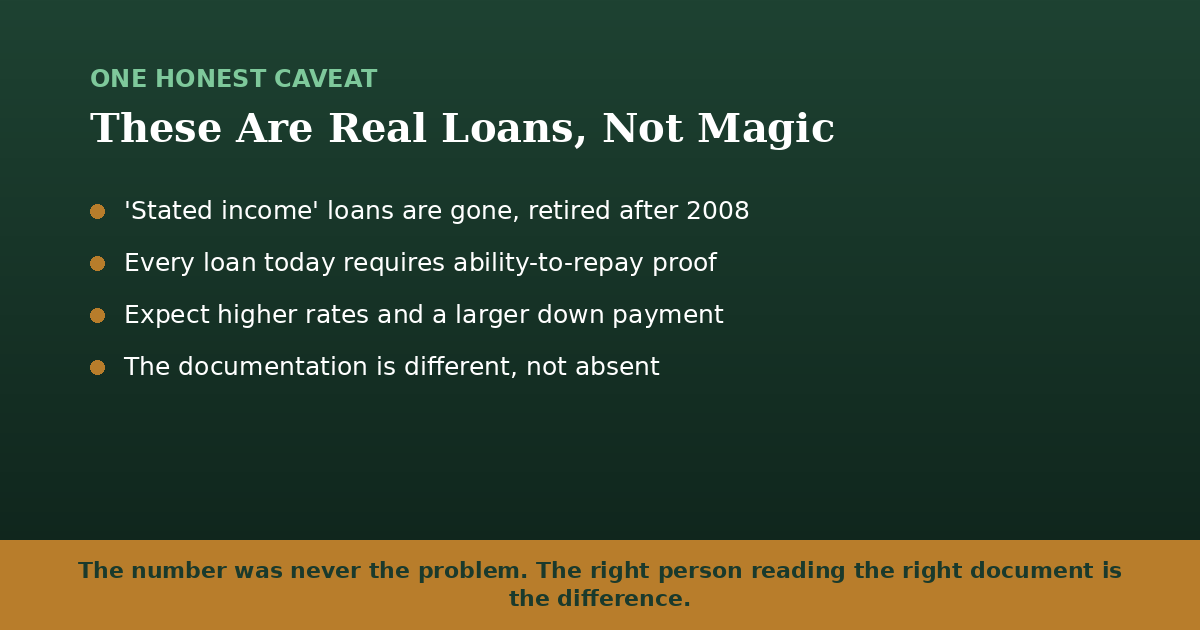
The old "stated income" loans, where you simply declared what you made, disappeared after 2008 and are not coming back. Every loan today requires ability-to-repay documentation; it's the law. Non-QM loans typically carry higher interest rates than conventional mortgages, often half a point to two points more, and frequently require a larger down payment, sometimes 10 to 20 percent. Credit standards still apply, usually a score around 620 or higher. The documentation isn't absent. It's just different, and honestly, often less painful than assembling two years of adjusted returns.
So the real lesson, whether you're the professional or the borrower, is this: a strong self-employed file rarely fails because the person can't afford the home. It fails when no one takes the time to package the income correctly and match it to the right program. The number was never really the problem. The right person, reading the right document, is the entire difference between "you don't qualify" and "here's exactly how we do this."
Sources: U.S. Bureau of Labor Statistics (self-employment levels, 2025); Optimal Blue (Non-QM volume growth 2023–2025); HousingWire, Bankrate, and industry Non-QM underwriting guidance (bank statement, 1099, P&L, and asset-depletion program requirements). Program availability, rates, and terms vary by lender and borrower profile. This article is general educational information, not lending or financial advice.