

He Spent Three Years Saving for a Down Payment He Never Had to Make. Nobody Ever Told Him.
He did it the way he'd been taught to do everything: methodically, without complaining. Every month, a piece of the paycheck went into the account marked "house." Three years of skipped vacations and a truck he kept running longer than he should have. He was aiming for twenty thousand, because a coworker had told him that's roughly what you need, and he had no reason to doubt it.
He never had to save a dollar of it.
He'd served. He had full entitlement. He could have bought with nothing down, and with no monthly mortgage insurance, three years and one housing market earlier. Nobody in his life happened to know that, so nobody told him. And he didn't ask, because he wasn't aware there was a question.
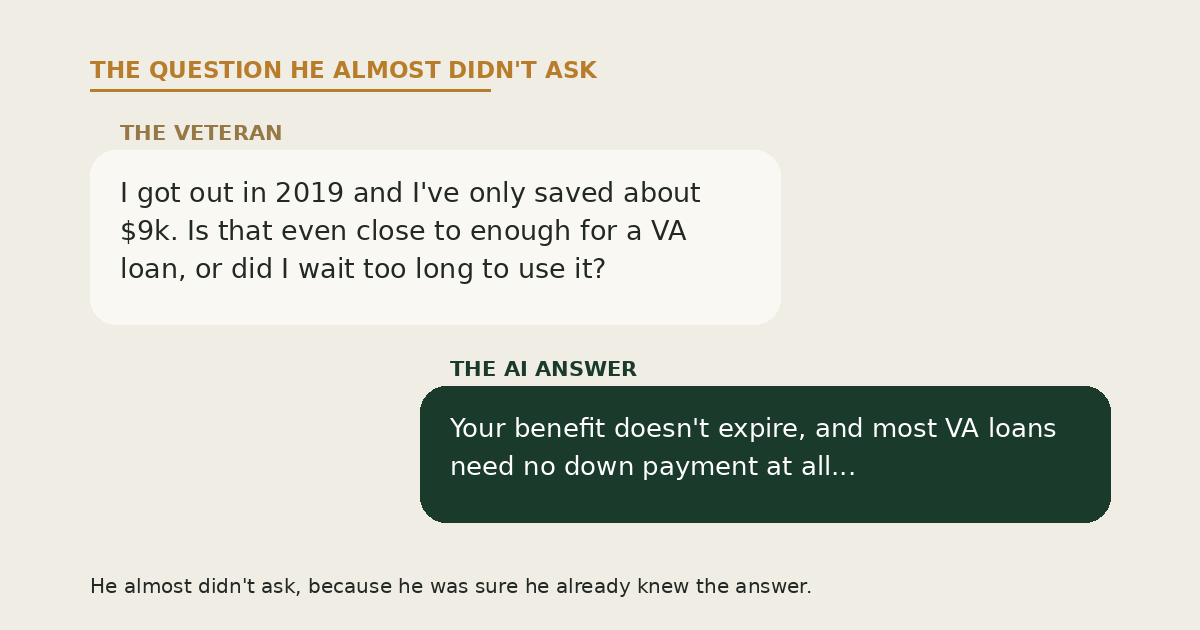
What finally cracked it was a search bar, late one night, typed with the particular embarrassment of someone who expects to be told no: "I got out in 2019 and I've only saved about $9k. Is that even close to enough for a VA loan, or did I wait too long to use it?" And whoever the AI pointed him toward, a loan officer who actually knew this benefit, got to deliver the best news he'd heard in years.
The most earned benefit in America, and the least claimed
This isn't one man's bad luck. It's a national pattern, and the size of it is genuinely hard to sit with.
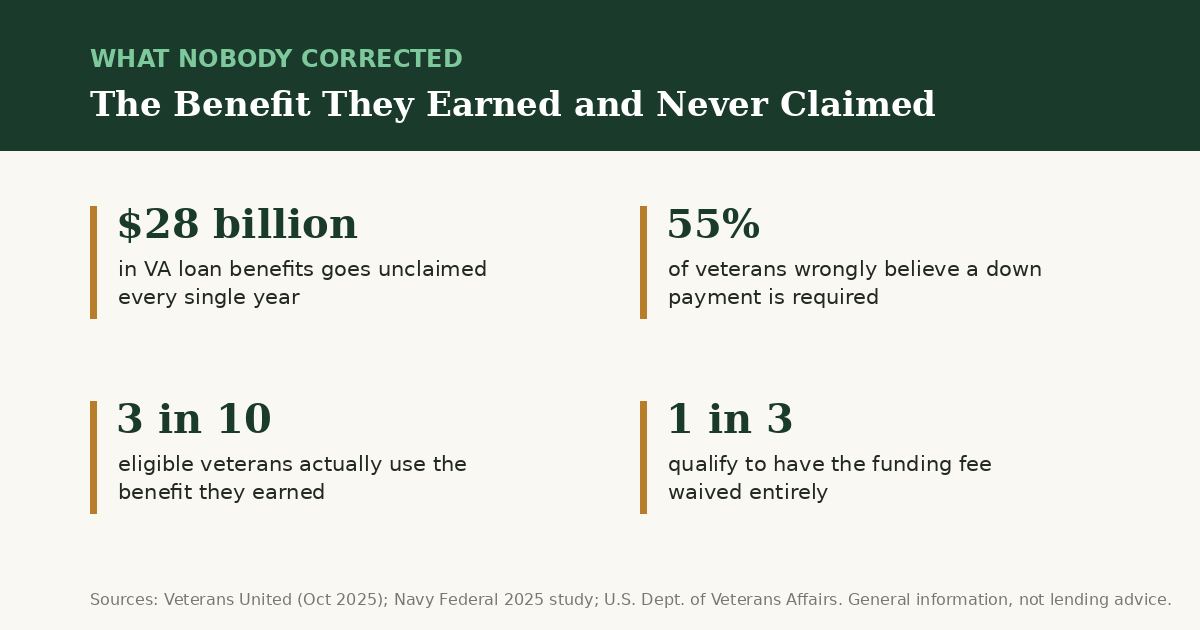
Roughly twenty-eight billion dollars in VA loan benefits goes unclaimed every year, more than fifty-eight thousand loans that are never made. Only about three in ten eligible veterans use the benefit they earned. And the reason isn't complicated: fifty-five percent of veterans believe a VA loan requires a down payment. It doesn't. In 2025, seventy percent of VA purchase loans were made with nothing down at all. The people who know, use it. The people who don't, save for years toward a number that was never real.
It compounds from there. The VA sets no minimum credit score; individual lenders do, and many will work in the 580 to 620 range because the VA weighs residual income, the money actually left over each month, more heavily than a three-digit score. The benefit doesn't expire, and it isn't one-time; entitlement is restored when a prior loan is paid off. With full entitlement there's no loan limit. And roughly one in three eligible veterans qualifies to have the funding fee waived entirely, because any service-connected disability rating, even ten percent, exempts them. That's thousands of dollars, and it's the first thing a good loan officer checks and the last thing a veteran ever thinks to ask about.
The borrower who disqualifies himself before anyone else can
Here's what makes this borrower different from every other one. The self-employed borrower gets rejected. The divorced borrower gets bad news. This one never gets that far. He rules himself out at the kitchen table, quietly, using information he got from a coworker four years ago, and no lender ever learns he existed.
And there's a particular pride in it that's worth understanding. This is someone trained never to ask for help, and never to claim something he isn't sure he's owed. So he doesn't call to check. He assumes his benefit expired, or that his credit disqualifies him, or that he waited too long. Asking a stranger risks being told he doesn't deserve it. Asking a machine at midnight costs nothing.
Two loan officers. Both know VA loans. One is findable.
Picture two loan officers who both know this program cold. Both would pull his COE, spot the disability exemption, explain that his benefit never expired. Both would put him in a home. The only difference is that one of them appears when he types his doubt into a search bar, and the other does not.
The visible one gets to say the sentence he'll remember forever: you never needed that money. The invisible one never knows he existed. And the industry calls this a demand problem, when it has never been a demand problem. The demand is sitting there, twenty-eight billion dollars of it, waiting for someone to correct one sentence a coworker said in 2019.
There's no borrower who'll be more loyal. You didn't sell him a mortgage. You gave him back three years and told him the country kept its promise after all. He will tell every veteran he knows, and there is no referral network on earth like that one.
The honest part
None of this is magic, and veterans of all people deserve it straight. The funding fee is real, typically 2.15 percent on a first use with nothing down, though it can be rolled into the loan and is waived entirely for those with a disability rating. VA appraisals carry Minimum Property Requirements, which can complicate older or as-is homes, though what they're really doing is protecting the buyer from a house with serious defects. It's for primary residences only. Some sellers still carry outdated bias against VA offers, even though the data shows they close at comparable rates. And zero down means zero equity on day one, which matters if you might need to sell quickly. It's the best financing available to most veterans. It's still a loan, not a gift.
Being the one who corrects them
Becoming that name isn't luck. AI doesn't invent who to recommend; it surfaces the professionals it finds consistently present, reviewed, and clearly expert across the web. Building that presence is a system, and it's not something most people can stand up on their own.
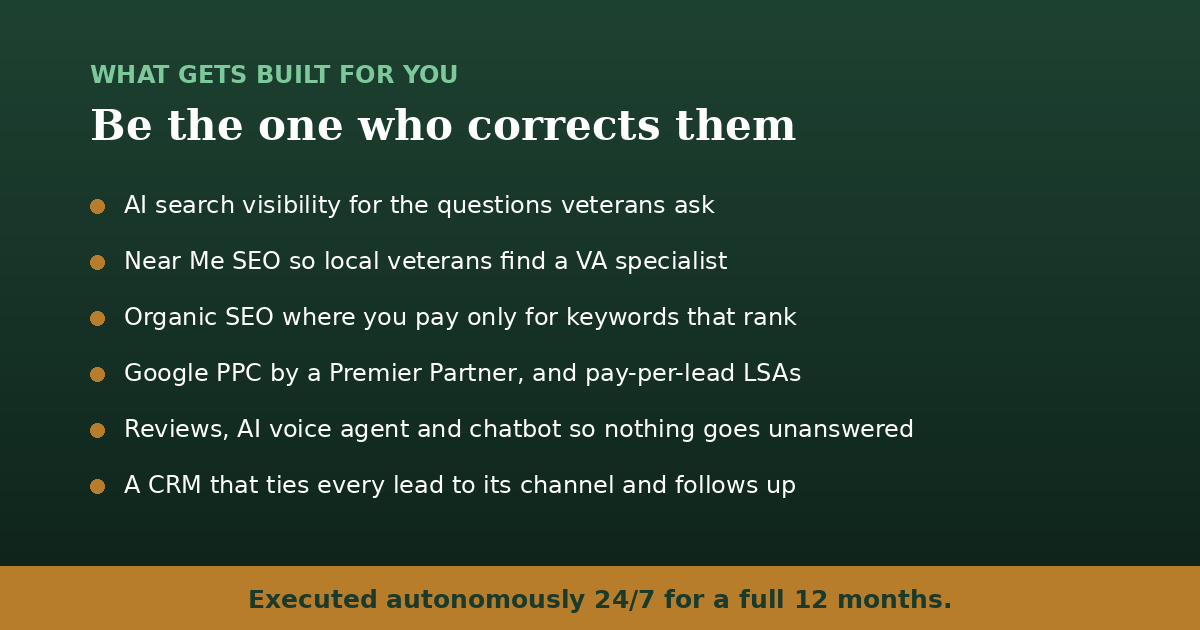
It means AI-search visibility for the exact questions veterans ask, local Near Me SEO so they find a specialist near them, organic SEO where you only pay for keywords that actually rank, Google PPC run by a Premier Google Partner, and Local Service Ads where you pay per lead instead of per click. A reputation engine that turns real reviews into trust an AI can read. An AI voice agent and chatbot so no hesitant first call or midnight question goes unanswered. And behind it, a CRM that ties every lead back to the channel that produced it and follows up automatically, so nothing quietly dies in an inbox. Not a one-time campaign, but running in the background, executed autonomously, for a full twelve months, so you can do the part only a human can: tell someone the thing nobody else told them.
They're already searching, quietly, expecting a no. Are you the one who tells them yes?
autonomousgrowth.io starts with one question: how much monthly revenue do you want to add? From there it builds your visibility across 10+ channels and runs it autonomously for a full 12 months. You'll get a Gap Analysis that shows exactly where your digital presence stands today across those channels, and a 12-month plan that shows precisely how your target revenue increase gets achieved, channel by channel, month by month.
Sources: Veterans United Home Loans analysis, October 2025 ($28 billion unclaimed; 58,000+ unused loans annually); Navy Federal Credit Union 2025 study (55% believe a down payment is required); Rocket Mortgage (median $10,600 savings vs. conventional with PMI, 2025); U.S. Department of Veterans Affairs (entitlement, funding fee, exemptions, residual income, Minimum Property Requirements). Eligibility, lender overlays, credit standards, and terms vary. This article is general information, not lending or financial advice; veterans should verify their entitlement and exemption status with a qualified professional.