
No One in Her Family Had Ever Owned a Home. She Didn't Know Where to Start, So She Asked AI Who to Trust.
Her parents rented their whole lives. So did her grandparents. In her family, a house was something other people owned, the kind of thing that happened to families who started with more than hers did. She never questioned it. It was just the shape of the world she grew up in.
Then one day, doing better than she'd expected in a job she was proud of, the thought crept in anyway: could I? And immediately the wall went up. She didn't know what a good rate was. She didn't know how much she needed to save. She didn't have a parent to call who had done this before, or an uncle who'd say "here's who we used." She had no one to ask, because no one in her family had ever been down this road.
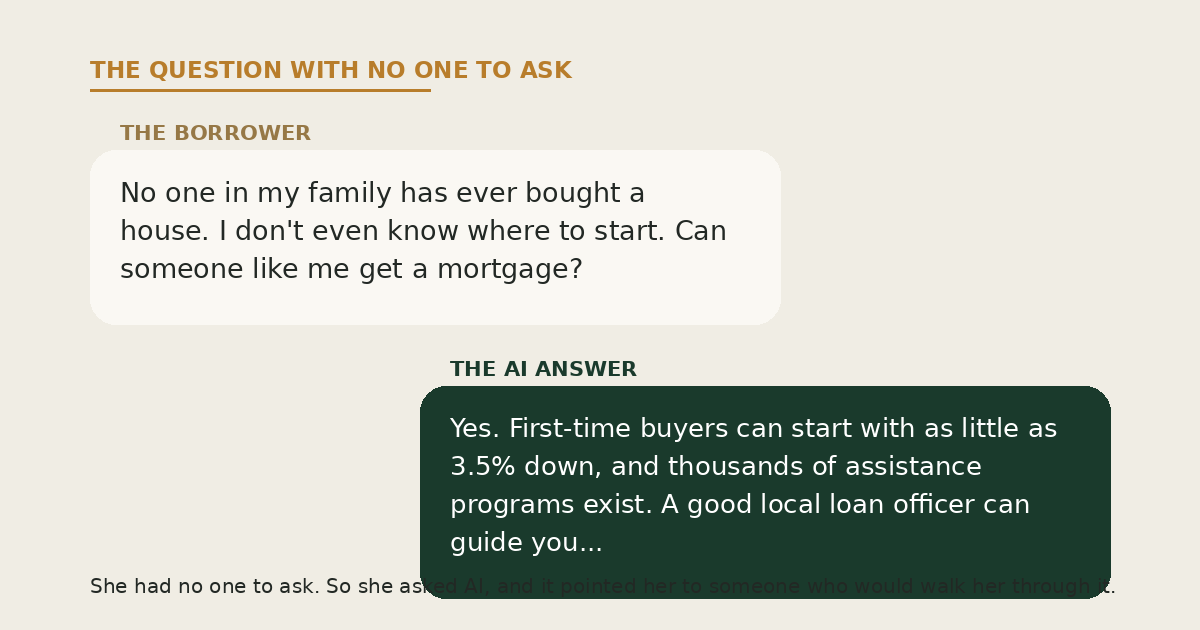
So she asked the only thing that wouldn't make her feel foolish for not knowing. Late one evening she typed it out: "No one in my family has ever bought a house. I don't even know where to start. Can someone like me get a mortgage?" And whoever the AI pointed her toward, the loan officer who actually knew how to guide a first-generation buyer, became the first person to tell her the door wasn't closed after all.
The door is more open than it looks from the outside
Here's what almost no first-generation buyer knows, because there's no one at home to tell them. The picture in their head, 20% down, perfect credit, a lawyer's income, is not the picture the rules actually paint.
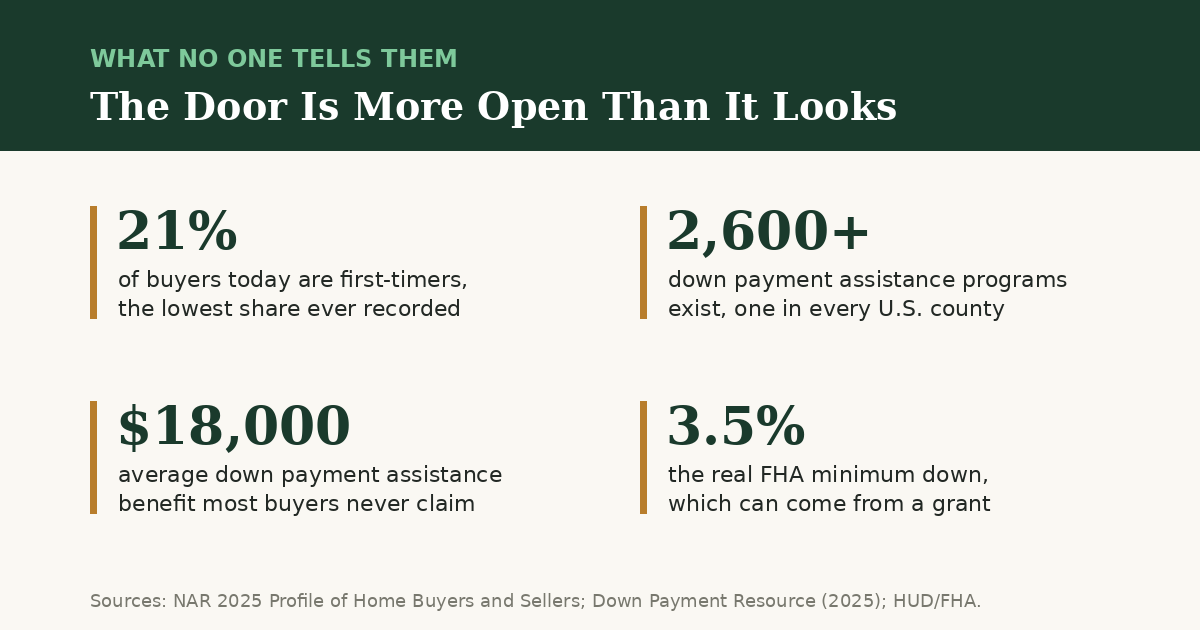
First-time buyers now make up just 21% of the market, the lowest share ever recorded, and the typical first-time buyer is 40 years old. That's not because the door is closed. It's largely because so many people believe it is, and never walk up to it. Meanwhile there are more than 2,600 down payment assistance programs across the country, at least one in every single U.S. county, with an average benefit around $18,000. Most buyers never claim a dime of it, because they never learn it exists.
And the biggest myth of all: FHA loans start at just 3.5% down, and that money can come from a gift or a grant, not years of savings a first-generation buyer may not have had the chance to build. The wall in her head was real. The wall in the rulebook was not.
The one borrower who truly has no one to ask
Every borrower feels some nervousness. But the first-generation buyer carries something else: the quiet certainty that this world wasn't built for people like them, and the very real absence of anyone in their life who's done it before. No parent who bought in the eighties. No sibling who just closed. No family loan officer passed down like an heirloom.
So when the question finally surfaces, they don't take it to a person, because there's no obvious person to take it to, and asking a stranger risks exposing how much they don't know. They take it to a search bar, where ignorance is safe and no one is watching. For this buyer, AI isn't a convenience. It's the first door they're willing to knock on.
Two loan officers. Both would guide her well. One is findable.
Picture two loan officers who both genuinely love working with first-time buyers, who'd patiently explain every step, who know exactly which assistance programs she'd qualify for. Both would change her life. The only difference is that one of them appears when she asks AI where to start, and the other does not.
The visible one gets to be the first person who ever told her it was possible, and the one she'll remember for the rest of her life. The invisible one never knows she existed. And this borrower, more than any other, becomes a lifelong client and a source of referrals, because you weren't just her lender. You were the guide her family never had.
For a loan officer, there may be no more meaningful borrower to reach. But you can only be that guide if she can find you at the exact moment she works up the courage to look.
Being the guide they don't have at home
Becoming the name AI surfaces for these questions isn't luck. AI doesn't invent who to recommend; it surfaces the professionals it finds consistently present, reviewed, and clearly expert across the web. Building that presence is a system, and it's not something most people can stand up on their own.
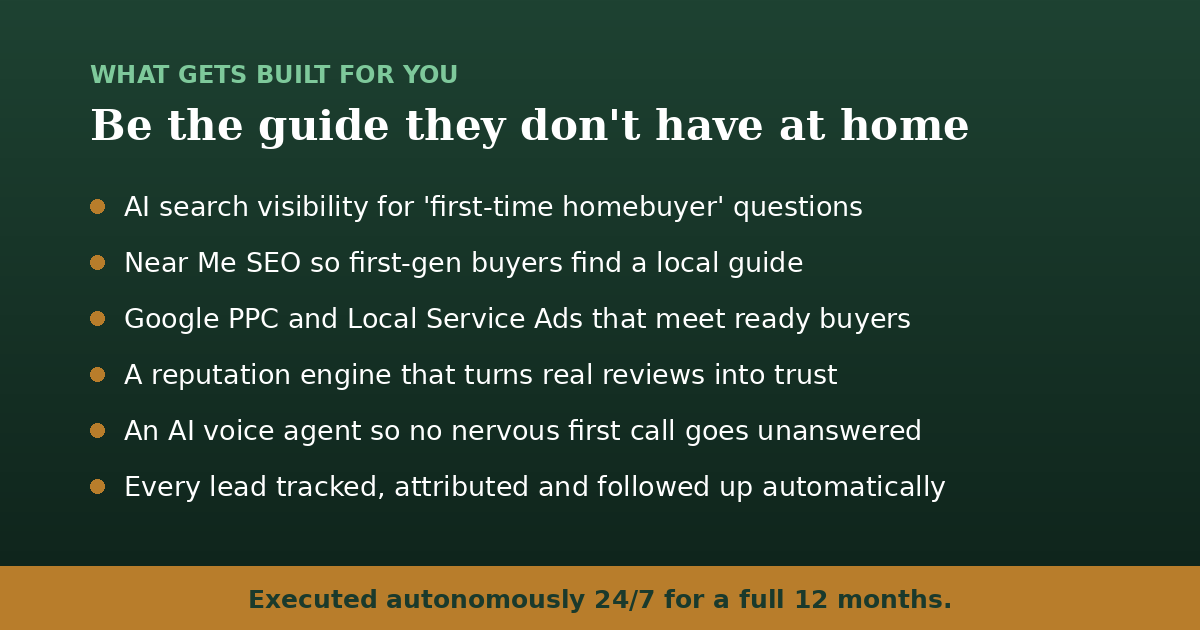
It means AI-search visibility for the exact questions first-time buyers ask, local Near Me SEO so they find a guide near them, paid search and Local Service Ads that meet ready buyers, a reputation engine that turns real reviews into trust an AI can read, and an AI voice agent so that no nervous first call, the hardest one they'll ever make, ever goes unanswered. Every lead tracked and followed up. Not a one-time campaign, but running quietly in the background, executed autonomously, for a full twelve months, so you can do the part only a human can: sit across from someone and tell them their family's story is about to change.
The buyers who think the door is closed are already searching. Are you the one who opens it?
autonomousgrowth.io starts with one question: how much monthly revenue do you want to add? From there it builds your visibility across 10+ channels and runs it autonomously for a full 12 months. You'll get a Gap Analysis that shows exactly where your digital presence stands today across those channels, and a 12-month plan that shows precisely how your target revenue increase gets achieved, channel by channel, month by month.
Sources: National Association of REALTORS® 2025 Profile of Home Buyers and Sellers (first-time buyer share and median age); Down Payment Resource 2025 Homeownership Program Index (assistance program counts and average benefit); U.S. Department of Housing and Urban Development / FHA (down payment requirements). Program eligibility and terms vary by location and lender. This article is general information, not lending advice.