

Fix Everything on Your Website. Nothing Will Happen.
The assistants already read your site. That is exactly why the audit changes so little.
There is a whole category of agency selling AI visibility audits now. Schema markup. Structured data. Crawlability. Headings shaped like answers. A report with red and amber and green, a list of fixes, and an invoice.
Almost none of it is wrong. Almost none of it matters either, and the reason sits in a fact everyone in the industry knows and nobody selling audits says out loud.
The assistants have already read your site.
Every one of these systems was built by ingesting the open web at enormous scale. Your pages are in there. So are your competitors'. Nobody was asked and nobody had to submit anything. Clean site structure makes those pages marginally easier to parse, and that is genuinely worth having — but it sets the floor, not the ceiling. If being readable were the deciding factor, every business with a well-built site would already be recommended, and they plainly are not.
What actually decides the answer
An assistant answering "who should I use for this" is not consulting a list of well-structured websites. It is producing the names it keeps encountering across the sources it trusts — news sites, video platforms, podcasts, trade publications, the places its answers get cited from.
Which is why the audit industry avoids it. Improving your markup is a job you can finish in an afternoon and invoice for. Producing enough genuine coverage across enough trusted places to change which names an assistant reaches for is slow, expensive and unglamorous. It is also the only part that moves the needle.
Two ways of publishing, and only one of them lasts
Once people understand that volume of mentions matters, the obvious move is to produce volume. Point an AI writer at a topic list, generate several hundred articles, publish them all on your own domain.
The shape of what happens next is well known to anyone who has watched it.
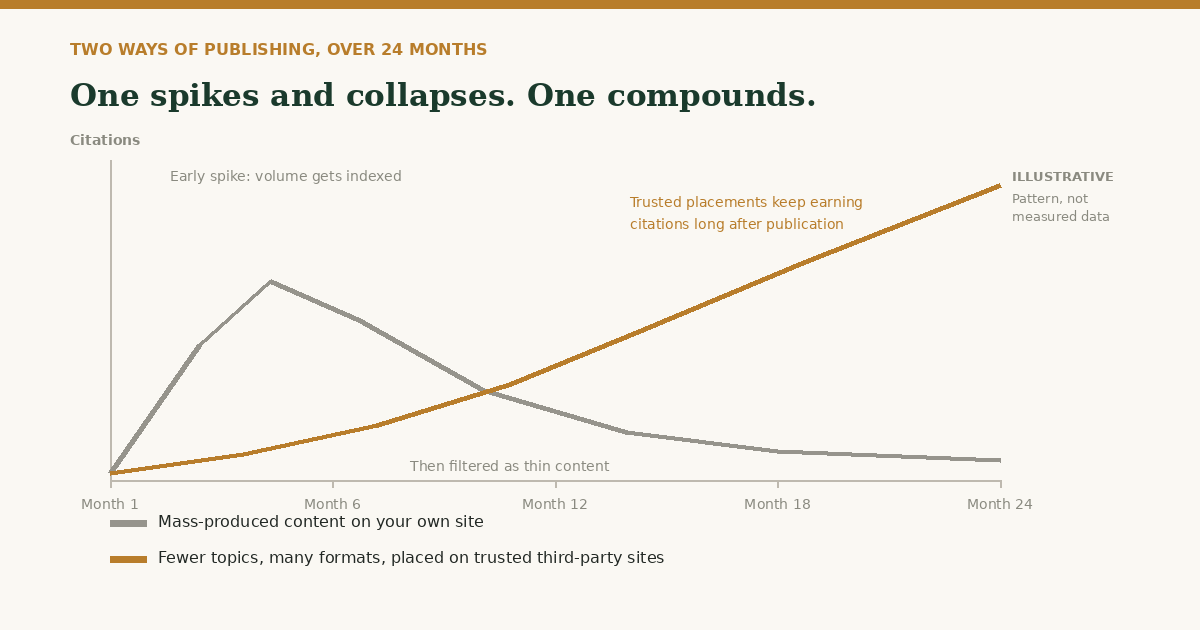
There is an early spike. The pages get indexed, they are new, the numbers move. For a few months it looks like it worked.
Then it collapses. The content is thin, it lives on one domain, nobody else references it, and it carries no authority signal of any kind. Search engines and assistants both filter it — this is not a secret algorithm, it is stated spam policy at every major platform. What was a spike becomes a penalty, and the site ends up worse off than before it started.
The other pattern looks unimpressive at first and behaves in the opposite way. Fewer topics. Each one turned into several genuinely different formats — an article, a video, an audio version, a slide deck, a press release, a social post — and each placed on established third-party sites and platforms rather than your own.
That starts slower. There is no spike. But every placement sits on a domain that already has standing, keeps getting cited, and keeps working long after it went live. Nothing decays, so each new campaign adds to a base rather than replacing it. Eighteen months in, the two lines are not close.
Why the third-party part is the whole point
Your own website answers questions about you. That is what it is for, and it does that job well — ask an assistant about your company by name and it will describe you accurately, citing your site.
But the questions that decide a sale are not about you. They are about the category. Which provider is better. Who is fastest. Who should I actually use. Those get answered from review sites, comparison articles, forum threads, industry press and video — sources you do not own and cannot optimise.
That is the structural reason a technical audit cannot fix the problem. It is confined to the one domain that was never going to produce the answer.
Three questions before you buy an audit
If your site is genuinely broken, fix it. Then ask the person selling you the audit three things.
Which of the five major assistants currently never names us, and will this fix change that? Most businesses have at least one they are effectively invisible on, and structure is rarely the cause.
What happens to the questions asked last, when a buyer is choosing between named providers? Those are answered off your domain entirely.
And can you show me a case where markup alone moved a brand into an answer it was previously absent from?
They are fair questions. They are rarely answered, because the honest answer is that the lever is somewhere else — out on other people's pages, where the assistants are actually reading.
This article is brought to you by autonomousgrowth.io.